

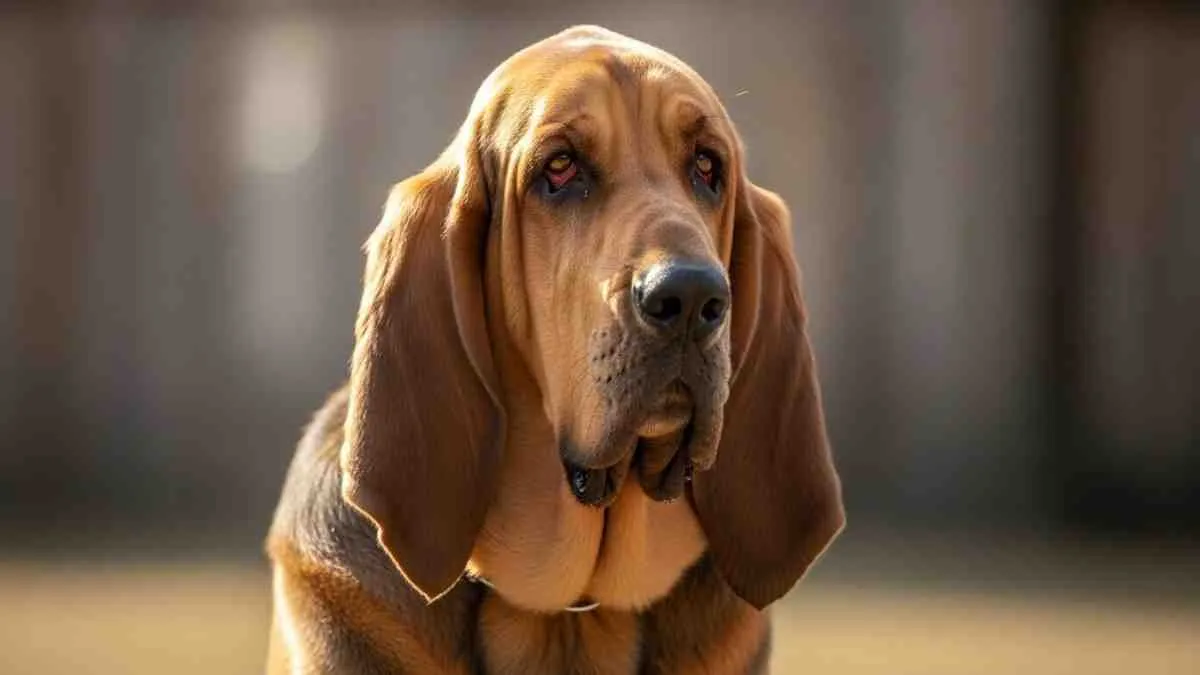
Have you been stumped by the NYT Mini crossword clue asking about “features of bloodhounds that are said to be 1,000 times stronger than humans”? You’re not alone. This cleverly worded puzzle has challenged crossword enthusiasts and dog lovers alike. The answer is simpler than you might think, but the science behind it is absolutely fascinating.
In this comprehensive guide, we’ll reveal the answer, explore why it’s correct, and dive deep into the remarkable biology that makes bloodhounds one of nature’s most powerful tracking animals. Whether you’re a crossword solver looking for quick answers or a curious reader wanting to understand these incredible dogs, you’ll find everything you need right here.
Understanding the “Features of Bloodhounds” NYT Crossword Clue
The Clue Breakdown
The New York Times Mini crossword clue reads: “Features of bloodhounds that are said to be 1,000 times stronger than humans.”
This clue appeared in the NYT Mini puzzle on August 7, 2025, and quickly became one of the more memorable entries due to its blend of animal biology and surprising statistics.
The Answer: NOSES
The correct answer to this crossword clue is NOSES (5 letters).
Why NOSES? Because a bloodhound’s sense of smell—centered in their remarkable noses—is approximately 1,000 to 10,000 times more sensitive than that of humans. This isn’t just crossword trivia; it’s supported by decades of scientific research into canine olfactory capabilities.
About NYT Mini Crosswords
The New York Times Mini crossword is a scaled-down version of the traditional NYT crossword puzzle, designed for quick solving sessions. These puzzles typically feature:
- 5×5 grid format
- Short answers (3-5 letters usually)
- Pop culture, science, and general knowledge clues
- Daily availability with varying difficulty levels
The “features of bloodhounds” clue fits perfectly into this format with its concise five-letter answer that packs a punch of interesting information.
Why the Answer is NOSES: The Scientific Explanation
The Power of the Bloodhound Nose
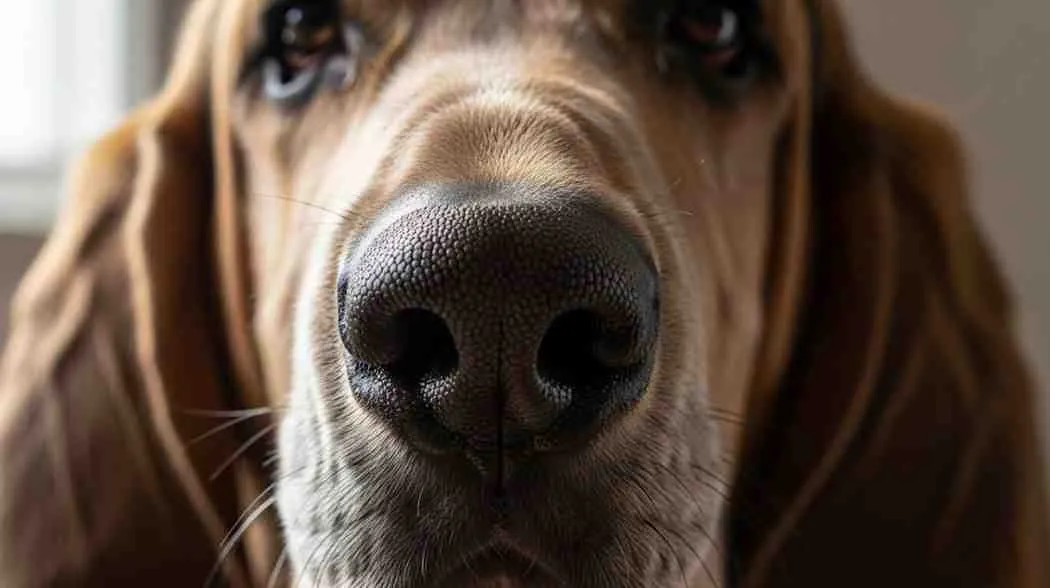
Bloodhounds possess what scientists consider one of the most powerful noses in the animal kingdom. But what makes their noses so extraordinary?
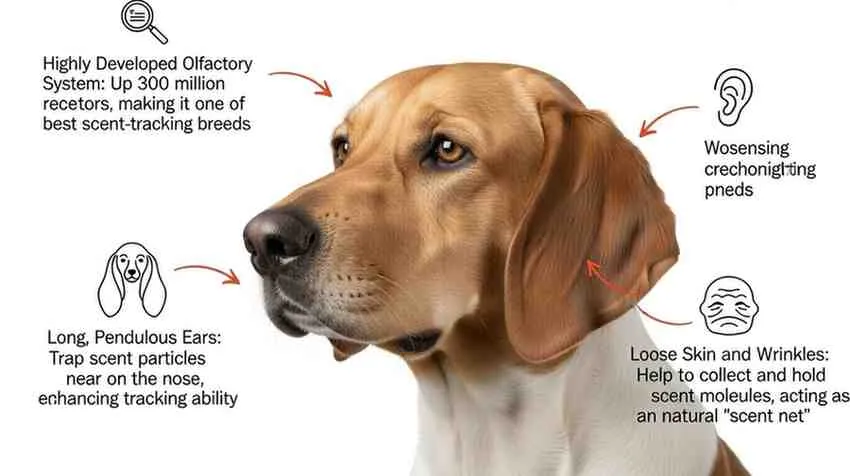
Olfactory Receptors: The secret lies in specialized cells called olfactory receptors. Humans have approximately 5 million olfactory receptor cells. Bloodhounds, by comparison, have around 300 million. This massive difference in receptor count translates directly to scent detection capability.
Brain Processing Power: It’s not just about the receptors. The portion of a bloodhound’s brain dedicated to analyzing smells is proportionally 40 times larger than a human’s. This means they not only detect more scent particles but process them far more effectively.
The 1,000 Times Stronger Claim
When we say a bloodhound’s nose is “1,000 times stronger” than a human’s, we’re referring to scent sensitivity and discrimination ability. Here’s what this means in practical terms:
- Detection Threshold: Bloodhounds can detect scents at concentrations as low as one part per trillion—imagine detecting a single drop of blood in five quarts of water.
- Scent Discrimination: They can identify and follow a specific person’s scent trail even in areas where hundreds of people have walked.
- Time Sensitivity: Bloodhounds can track scents that are several days old, sometimes even up to two weeks in ideal conditions.
Research published in various veterinary and behavioral science journals confirms that bloodhounds’ scenting ability ranges from 1,000 to 10,000 times more acute than humans, depending on the specific scent compound being detected.
Biological Mechanisms Behind Super Smelling
The bloodhound’s extraordinary nose works through several specialized features:
Nasal Folds and Surface Area: The interior of a bloodhound’s nose contains elaborate folds that increase surface area dramatically. More surface area means more opportunities for scent molecules to bind with receptors.
Vomeronasal Organ: Also called Jacobson’s organ, this specialized structure detects pheromones and other chemical signals that humans can’t perceive at all.
Independent Nostril Function: Bloodhounds can smell in stereo, with each nostril processing information independently. This helps them determine the direction of a scent trail.
Bloodhound Characteristics and Scent-Tracking Abilities
Physical Features That Enhance Tracking
Bloodhounds aren’t just about their noses. Their entire body is designed for scent tracking:
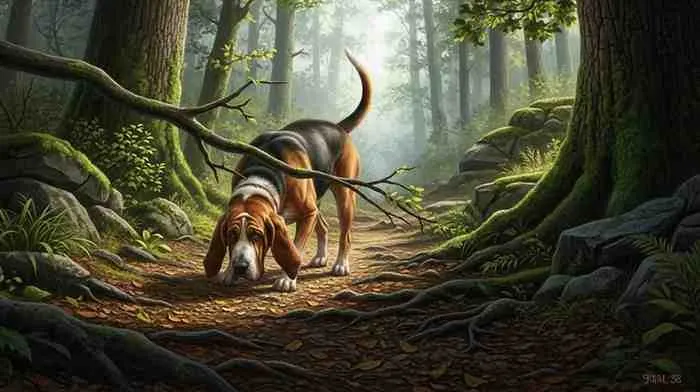
Droopy Ears: Those long, floppy ears aren’t just adorable—they serve a crucial function. As bloodhounds walk with their noses to the ground, their ears sweep forward and help funnel scent particles toward their nose.
Wrinkled Skin: The loose, wrinkled skin around a bloodhound’s face and neck traps scent particles, creating a sort of scent reservoir that allows them to analyze smells even after moving past the source.
Large Jowls: The pendulous lips and jowls produce copious saliva, which helps capture and concentrate scent molecules for better detection.
Body Build: Bloodhounds have a strong, muscular build with long legs that allow them to cover difficult terrain while maintaining their nose position close to the ground for hours.
How Bloodhounds Track
The tracking process is a marvel of biology and training:
- Scent Article Introduction: Handlers present the bloodhound with an item containing the target scent (clothing, a personal item, etc.).
- Scent Discrimination: The dog memorizes the unique scent profile of the individual.
- Trail Following: The bloodhound follows microscopic skin cells (called rafts) that constantly fall from every person’s body.
- Persistence: Bloodhounds can follow trails for miles, maintaining focus for extended periods that would exhaust other breeds.
Real-Life Tracking Applications
Bloodhounds serve in various critical roles:
Law Enforcement: Police departments use bloodhounds to track fleeing suspects, often with remarkable success rates. Their scent evidence has been admitted in court proceedings in many jurisdictions.
Search and Rescue: When hikers go missing or children wander from home, bloodhounds can locate them by following scent trails through wilderness areas.
Cadaver Detection: Some bloodhounds are trained specifically to detect human remains, assisting in criminal investigations and disaster recovery.
Conservation Work: Bloodhounds help track endangered species and detect invasive species in environmental protection efforts.
Famous Bloodhound Tracking Stories
Throughout history, bloodhounds have achieved remarkable tracking feats:
- Nick Carter, a legendary Kentucky bloodhound, reportedly helped solve over 600 crimes in the early 1900s and once followed a scent trail that was 105 hours old.
- In 2015, a bloodhound named Ludivine accidentally joined a half-marathon in Alabama, finished 7th overall, and became an internet sensation—though this was more about wandering than tracking!
- Law enforcement bloodhounds have successfully tracked suspects across rivers, through urban environments, and over distances exceeding 10 miles.
Crossword Variations and Similar Clue Answers
Common Short Answers for Dog-Related Clues
If you’re solving crosswords regularly, you’ll encounter various short answers related to scent and bloodhounds:
SCENT (5 letters): Often appears in clues about trails, perfumes, or detection work. Example clue: “What a bloodhound follows.”
SNIFF (5 letters): Common verb associated with smelling. Example clue: “Investigate, dog-style.”
ODOR (4 letters): General term for smell. Example clue: “Something detected by the nose.”
SMELL (5 letters): Basic sense term. Example clue: “One of the five senses.”
JOWL (4 letters): Refers to the droopy cheeks. Example clue: “Bloodhound facial feature.”
SPOOR (5 letters): Tracking term for animal trail. Example clue: “Trail for a tracker.”
SENSE (5 letters): General ability term. Example clue: “Of smell (5 letters).”
Tips for Solving Similar Crossword Clues
When you encounter clues about bloodhounds or dog senses:
- Count the letters first: This immediately narrows your options.
- Look for comparative language: Words like “stronger,” “better,” or “times more” suggest a specific feature being highlighted.
- Consider plural vs. singular: “NOSES” vs. “NOSE” can make or break your answer.
- Think anatomically: Dog-related clues often reference specific body parts—ears, nose, paws, tail.
- Cross-reference with intersecting answers: The letters you’ve already filled in will confirm or eliminate possibilities.
Related NYT Mini Crossword Patterns
The NYT Mini frequently features:
- Animal biology facts
- Comparative statistics (X times stronger/faster/bigger)
- Five-letter answers that reference plural body parts
- Science-based trivia presented accessibly
Understanding these patterns helps you anticipate answer types even before fully reading the clue.
Bloodhound Smell vs. Human Smell: The Comparison
The Numbers Behind the Difference
Let’s break down exactly how bloodhound and human olfactory systems compare:
| Feature | Humans | Bloodhounds |
|---|---|---|
| Olfactory Receptors | ~5 million | ~300 million |
| Genes Devoted to Smell | ~400 | ~1,200 |
| Brain Area for Smell Processing | ~1% | ~40% |
| Sensitivity Multiplier | Baseline (1x) | 1,000-10,000x |
| Scent Trail Age Detection | Hours | Days to weeks |
What Humans Can’t Smell That Bloodhounds Can
The difference isn’t just about intensity—it’s about capability:
Individual Human Scent: Every person has a unique scent profile based on genetics, diet, environment, and microbiome. Bloodhounds can distinguish between identical twins by scent alone. Humans can’t consciously detect these differences at all.
Old Scents: While humans might smell a perfume that was sprayed an hour ago, bloodhounds can detect and follow scent trails that are days old, long after humans would perceive nothing.
Dilute Concentrations: Bloodhounds detect scent molecules at concentrations thousands of times lower than human detection thresholds.
Layered Scents: In an environment with multiple overlapping smells, humans become overwhelmed. Bloodhounds can separate and identify individual scent components like reading different words on a page.
Why Such a Dramatic Difference Evolved
Evolution shaped dogs’ noses through thousands of years of natural and artificial selection:
Survival Advantage: Wild canine ancestors needed excellent scenting to hunt prey, avoid predators, and find mates.
Selective Breeding: Humans specifically bred bloodhounds (and other scent hounds) to enhance tracking abilities, creating dogs with extreme olfactory specialization.
Trade-offs: While bloodhounds gained extraordinary smell, they sacrificed some visual acuity. Humans evolved to rely more heavily on vision and less on smell.
Case Studies: Bloodhounds in Action
Legal Recognition of Bloodhound Evidence
Bloodhound tracking evidence has been used in court cases for over a century:
Admissibility Standards: Courts typically allow bloodhound tracking evidence when the dog has documented training, the handler followed proper procedures, and the trail was relatively fresh.
Limitations: While tracking can establish a person’s presence in an area, it’s usually considered corroborative evidence rather than definitive proof on its own.
Famous Cases: Bloodhound evidence has helped solve murders, locate kidnapping victims, and track escaped prisoners across multiple states.
Search and Rescue Success Stories
Bloodhounds have saved countless lives through search and rescue operations:
Missing Children: When a child wanders from home, bloodhounds can often locate them within hours by following their scent trail, even through wooded areas.
Disaster Response: After earthquakes, floods, or building collapses, bloodhounds help locate survivors trapped in debris.
Wilderness Rescues: Lost hikers in national parks are frequently found by bloodhound teams who can follow trails over rocky terrain where visual tracking fails.
The Training Process
Creating an effective tracking bloodhound requires extensive training:
- Early Socialization (8-16 weeks): Puppies learn to focus despite distractions.
- Basic Scent Work (4-6 months): Introduction to following simple trails.
- Advanced Tracking (6-12 months): Longer trails, older scents, difficult terrain.
- Certification (12+ months): Formal testing to verify tracking reliability.
- Ongoing Training: Lifetime practice to maintain skills and handler partnership.
Professional tracking bloodhounds represent a significant investment of time and resources, but their capabilities make them irreplaceable in certain situations.
Frequently Asked Questions (FAQs)
What is the answer to “features of bloodhounds that are said to be 1,000 times stronger than humans”?
The answer is NOSES. This refers to the bloodhound’s sense of smell, which operates through their noses and is approximately 1,000 to 10,000 times more sensitive than human olfaction.
How many times stronger is a bloodhound’s sense of smell than a human’s?
Scientific research indicates that bloodhounds have olfactory capabilities that are between 1,000 and 10,000 times more sensitive than humans, depending on the specific compound being detected. This dramatic difference is due to having approximately 300 million olfactory receptors compared to humans’ 5 million.
Which body part of a bloodhound is 1,000x stronger than humans?
The nose (or more accurately, the olfactory system) is the body part that exhibits this remarkable sensitivity. While other dog senses may be enhanced compared to humans, the sense of smell shows the most dramatic difference.
Why do bloodhounds have such powerful noses?
Bloodhounds have powerful noses due to several factors:
- Approximately 300 million olfactory receptor cells
- A brain structure that dedicates 40% of its processing power to analyzing smells
- Physical features like wrinkled skin and droopy ears that help capture and concentrate scent particles
- Centuries of selective breeding specifically for tracking ability
What does the NYT Mini crossword clue “features of bloodhounds” refer to?
The clue refers to the bloodhound’s noses and their extraordinary scenting ability. The clue specifically highlights that this feature is said to be 1,000 times stronger than the equivalent human feature, pointing toward their sense of smell.
Are bloodhounds better at tracking than other dog breeds?
Bloodhounds are generally considered the premier tracking breed, though other scent hounds like Basset Hounds and Beagles also have excellent noses. Bloodhounds specifically excel at tracking human scent over long distances and time periods, which is why law enforcement prefers them.
Can bloodhounds really track scents that are days old?
Yes, under favorable conditions (cool, damp weather with minimal wind), trained bloodhounds can follow scent trails that are several days to even two weeks old. However, success rates decrease as trails age and environmental conditions affect scent preservation.
How accurate is bloodhound tracking evidence in court?
When properly documented and conducted by trained handler-dog teams, bloodhound tracking evidence is generally considered reliable corroborative evidence. However, it’s rarely used as the sole basis for conviction and is typically combined with other forms of evidence.
Do all bloodhounds make good tracking dogs?
While all bloodhounds have superior scenting ability compared to most breeds, not every individual bloodhound becomes an effective working tracker. Success requires proper breeding, extensive training, suitable temperament, and strong handler partnership.
What other animals have better senses of smell than bloodhounds?
Very few animals surpass bloodhounds in scenting ability. Bears have a comparable or possibly superior sense of smell, and some research suggests elephants may also have extraordinary olfactory capabilities. Among domestic animals, bloodhounds are essentially unmatched.
Conclusion
The NYT Mini crossword clue about “features of bloodhounds that are said to be 1,000 times stronger than humans” perfectly encapsulates how a simple five-letter answer—NOSES—can open the door to fascinating scientific discoveries.
We’ve explored why bloodhounds possess such extraordinary scenting abilities, from their 300 million olfactory receptors to their specialized brain structure. We’ve seen how their entire physical design, from droopy ears to wrinkled faces, supports their primary function as nature’s supreme tracking machines.
For crossword enthusiasts, remember that clues involving comparative statistics (“X times stronger/faster/better”) often point toward specific anatomical features or capabilities. The letter count and intersecting answers will guide you toward the correct response.
For dog lovers and science enthusiasts, the bloodhound reminds us that evolution and selective breeding can create truly remarkable specializations. These gentle giants can accomplish feats of scent detection that seem almost supernatural to us smell-limited humans.
Whether you stumbled upon this article while solving today’s crossword or because you’re genuinely curious about these amazing dogs, we hope you’ve found the answer you were seeking—and learned something fascinating along the way.
Have you encountered other interesting crossword clues about animals or science? Share them in the comments below! And if you need help with other NYT Mini crossword puzzles, let us know what clues are stumping you. We love exploring the fascinating facts behind crossword answers!
