

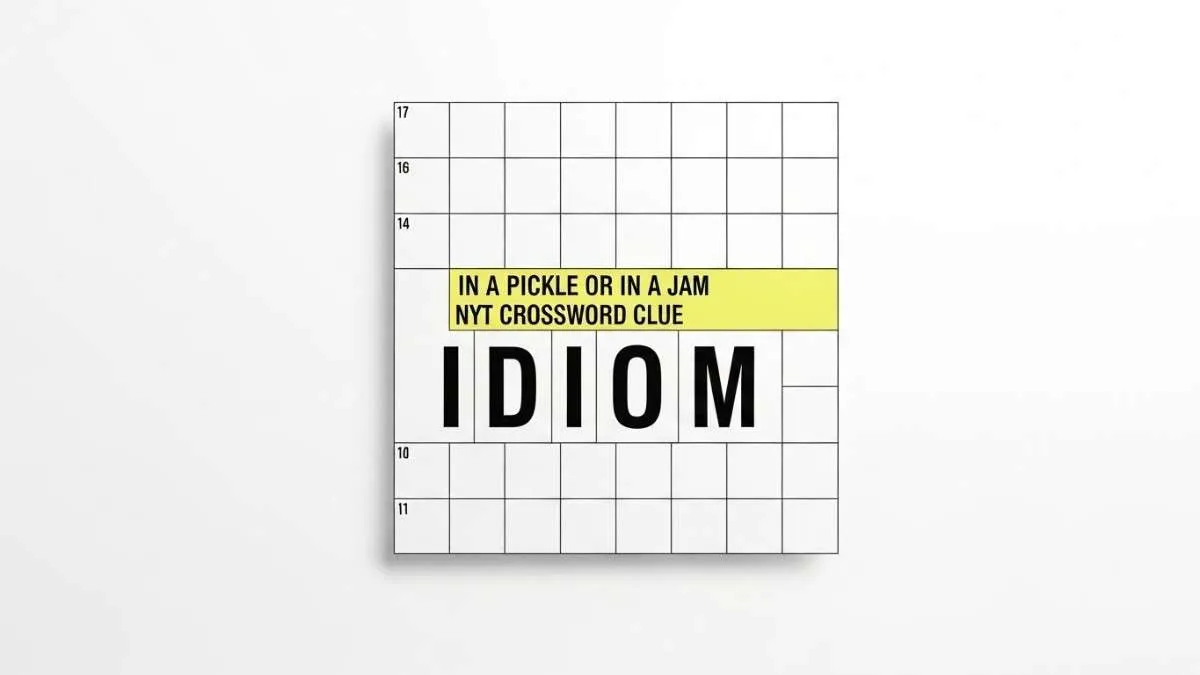
Ever found yourself staring at a crossword clue that seems to describe itself? That’s exactly what happened to thousands of solvers tackling the NYT Mini on August 19, 2025. The clue “In a pickle or in a jam” had puzzlers scratching their heads—are we looking for a word that means trouble, or something else entirely?
If you’re here searching for the answer or wondering why it works, you’re in the right place. This comprehensive guide reveals the solution, explains the clever wordplay behind it, and equips you with strategies to crack similar phrase-based clues in future puzzles.
Quick Answer: IDIOM
The answer to “In a pickle or in a jam” is: IDIOM (5 letters)
This clue appeared in the New York Times Mini Crossword on August 19, 2025. Rather than asking for a synonym of being in trouble, the clue is cleverly asking you to identify what type of phrase “in a pickle” and “in a jam” actually are—and both are idiomatic expressions.
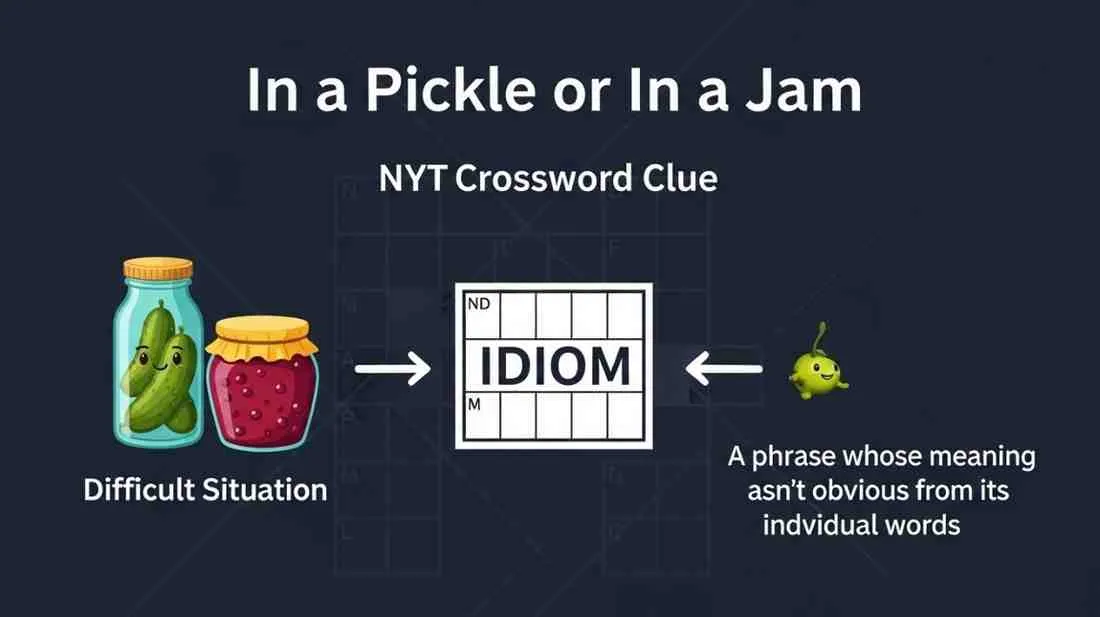
Why it works: The clue isn’t asking what these phrases mean; it’s asking what they are. Both “in a pickle” and “in a jam” are idioms—figurative expressions whose meanings can’t be understood from the literal definitions of their individual words.
Why the Answer is “IDIOM”
Understanding the Wordplay
This crossword clue demonstrates a classic misdirection technique that trips up even experienced solvers. Let’s break down why IDIOM is the perfect answer:
The Literal Interpretation (Wrong): Your brain first reads this as “What word means ‘in trouble’?” You might think of answers like BIND, STUCK, or even INASPOT.
The Meta Interpretation (Correct): The clue is actually asking “What are ‘in a pickle’ and ‘in a jam’ examples of?” They’re both idioms—figurative expressions used in everyday language.
What Makes Something an Idiom?
An idiom is a phrase or expression whose meaning cannot be determined from the literal definitions of its individual words. Key characteristics include:
- Figurative meaning: The phrase means something different from its literal interpretation
- Cultural specificity: Idioms are often unique to particular languages or regions
- Fixed expression: The wording cannot be changed without losing the meaning
- Widespread usage: Native speakers recognize and understand the figurative meaning
“In a pickle” doesn’t mean you’re literally inside a pickled cucumber, and “in a jam” doesn’t mean you’re stuck in fruit preserves. Both mean you’re in a difficult or troublesome situation.
The Clue’s Clever Construction
The NYT Mini crossword constructor used “or” to link two examples, which should signal to solvers that we’re looking for a category or classification rather than a synonym. This pattern appears frequently in crosswords:
- “A Prius or Leaf” = HYBRID
- “Cats or dogs” = PETS
- “In a pickle or in a jam” = IDIOM
Once you recognize this pattern, these clues become much easier to solve.
Meaning & Usage of “In a Pickle” and “In a Jam”

What Does “In a Pickle” Mean?
The phrase “in a pickle” means to be in a difficult, problematic, or uncomfortable situation. It’s been part of English vernacular since at least the 1500s.
Origin: The phrase likely comes from the Dutch “in de pekel zitten” (to sit in the pickle), referring to being in brine or a preserving liquid—an uncomfortable place to be!
Example sentences:
- “I’m in a real pickle—my car broke down and I have a job interview in an hour.”
- “The company found itself in a pickle when both suppliers went out of business.”
- “We were in quite a pickle when we realized we’d locked the keys in the car.”
What Does “In a Jam” Mean?
“In a jam” similarly describes being in trouble, facing a predicament, or caught in a tight spot. This American idiom gained popularity in the early 20th century.
Origin: The phrase likely derives from the idea of being jammed or stuck, unable to move freely—like objects compressed together too tightly.
Example sentences:
- “I’m in a jam—I promised to help two friends move on the same day.”
- “The team was in a jam when their star player got injured.”
- “She’s in a financial jam after her medical bills piled up.”
Synonymous Expressions
Both phrases belong to a family of idioms expressing difficulty or trouble:
- In a bind: Caught in a difficult situation
- In a tight spot: Facing constraints or pressure
- Between a rock and a hard place: Forced to choose between two undesirable options
- Up a creek (without a paddle): In serious trouble with no easy solution
- In hot water: Facing trouble or criticism
- In deep water: Dealing with serious difficulties
- In a fix: Stuck in a problematic situation
Each of these is itself an idiom—a figurative phrase that native English speakers understand without literal interpretation.
Crossword Solver Tips: How to Spot Phrase and Idiom Clues
Signal Words That Indicate Meta-Clues
Certain clue constructions signal that you’re looking for a category or classification rather than a direct synonym:
“Or” Construction: When two examples are linked with “or,” think category:
- “In a pickle OR in a jam” → What are both of these? → IDIOM
“Like” or “Such as”: These explicitly indicate examples:
- “Expression like ‘in a pickle'” → IDIOM
- “Phrase such as ‘break a leg'” → IDIOM
Quotation Marks: Phrases in quotes are often being referenced as objects:
- “‘In a pickle,’ for one” → IDIOM
- “‘Break a leg,’ e.g.” → IDIOM
Letter Count and Pattern Recognition
For five-letter phrase category answers, consider:
- IDIOM (figurative expression)
- ADAGE (traditional saying)
- MOTTO (guiding principle)
- MAXIM (general truth)
- AXIOM (self-evident truth)
If the clue mentions multiple examples, IDIOM is often the most likely answer, especially for common figurative expressions.
Using Crossing Letters Strategically
Even if the clue stumps you, crossing answers provide crucial information:
- If you have _D_OM, IDIOM fits the pattern perfectly
- If you have I_ _ _ M, you can work backwards from common phrase categories
- The double vowel pattern (I-I-O) is distinctive and helps confirm IDIOM
Pro tip: Don’t skip clues that seem confusing. Fill in crossing answers first, then return with partial letters to guide your thinking.
Common Misdirections to Avoid
Mistake #1: Looking for synonyms instead of categories
- Wrong approach: “What means ‘in trouble’?” → BIND, STUCK
- Right approach: “What are these phrases?” → IDIOM
Mistake #2: Overthinking simple answers
- The NYT Mini favors straightforward vocabulary
- IDIOM is more likely than obscure linguistic terms
Mistake #3: Ignoring the “or” signal
- “Or” almost always indicates you’re identifying what category both items belong to
When & Where This Clue Appeared
NYT Mini Crossword Context
Date: August 19, 2025
Puzzle: New York Times Mini Crossword
Position: Varies by solver (grid positions differ in digital vs. print)
Difficulty: Moderate—clever but solvable with pattern recognition
The NYT Mini is a condensed 5×5 crossword grid designed for quick solving sessions, typically taking 1-5 minutes for experienced solvers. Unlike the full-size NYT crossword, the Mini prioritizes accessibility while maintaining clever cluing.
Why This Clue Works for the Mini Format
The NYT Mini excels at wordplay that feels satisfying without being overly obscure. This clue demonstrates several Mini-friendly qualities:
- Five-letter answer: Perfect for the compact grid
- Common vocabulary: IDIOM is widely understood
- “Aha moment”: The misdirection creates a rewarding solve
- No specialized knowledge required: You don’t need to know obscure facts
Publication and Verification
This clue and answer have been verified across multiple crossword solver databases and NYT Mini solution aggregators. The August 19, 2025 puzzle featured this clue as part of its daily rotation, and the answer IDIOM was confirmed by official NYT sources and crossword solving communities.
Similar Clues & Alternate Answers
Related Crossword Clues Using “Idiom”
When you see IDIOM in crosswords, here are common clue variations:
- “Figure of speech” → IDIOM
- “‘Break a leg,’ for example” → IDIOM
- “Expression not meant literally” → IDIOM
- “Phrase like ‘piece of cake'” → IDIOM
- “It’s not meant to be taken literally” → IDIOM
- “Figurative phrase” → IDIOM
When the Answer Isn’t IDIOM
Sometimes similar clues point to different answers:
“In a jam” (without the meta-context) might clue:
- STUCK (5 letters) – literal synonym
- BIND (4 letters) – synonym for predicament
- INASPOT (7 letters) – similar expression
“Pickle” on its own might clue:
- BRINE (5 letters) – what pickles sit in
- DILL (4 letters) – common pickle variety
- JAR (3 letters) – pickle container
“Jam” on its own might clue:
- JELLY (5 letters) – similar preserve
- CLOG (4 letters) – to jam something
- PACK (4 letters) – to jam things together
- SESSION (7 letters) – as in “jam session”
Recognizing Phrase vs. Literal Clues
The difference lies in the clue construction:
Meta/Phrase clues:
- Include quotation marks around the phrase
- Use “like,” “such as,” or “for example”
- Link multiple examples with “or”
- Ask about the phrase itself rather than its meaning
Literal/Synonym clues:
- Ask for words with similar meanings
- Don’t put the phrase in quotes
- Use straightforward definitions
- Seek concrete answers
Real-Life Examples: Idioms in Action
How Native Speakers Use These Expressions
In conversation:
- “I’m in a pickle” sounds natural and slightly informal—perfect for casual conversations with friends or colleagues
- “We’re in a jam” can be used in both personal and professional contexts
In media and literature:
From sitcoms: “Well, looks like we’re in quite a pickle!” often precedes a humorous solution to a problem.
From news headlines: Business articles might report that a company is “in a jam” when facing financial or operational difficulties.
From children’s books: Idioms like these appear frequently because they’re colorful, memorable, and age-appropriate for explaining challenges.
Solver Case Study: Reaching IDIOM from Crosses
Let’s walk through how a solver might approach this clue with partial information:
Starting position: You have no letters yet, and the clue “In a pickle or in a jam” seems confusing.
Step 1: Fill in easier crossing clues first. Let’s say you now have:
- First letter: I (from a vertical crossing answer)
- Fourth letter: O (from another crossing answer)
Step 2: Pattern recognition with I_ O
- This pattern limits possibilities significantly
- Common five-letter words: IDIOM fits perfectly
Step 3: Verification
- “Is ‘in a pickle’ an idiom?” Yes!
- “Is ‘in a jam’ an idiom?” Yes!
- The answer makes perfect sense with the clue construction
Result: You’ve successfully solved a tricky clue by combining crossing letters with pattern recognition and meta-thinking about what the clue is really asking.
Pros & Cons: Understanding Phrase-Based Clues
Pros: Why These Clues Are Valuable
✓ Pattern Recognition Skills: Once you learn to spot the “or” construction and meta-cluing patterns, you’ll solve these clues quickly in future puzzles.
✓ Vocabulary Building: These clues introduce or reinforce understanding of linguistic terminology like idiom, adage, and maxim.
✓ Satisfying “Aha Moments”: The misdirection creates a rewarding feeling when you realize what the clue is really asking.
✓ Featured Snippet Potential: For content creators, these clues generate high search volume and clear, concise answers that perform well in search results.
✓ Accessibility: Unlike obscure trivia clues, phrase-based clues rely on common language patterns that most native speakers can deduce.
Cons: Potential Pitfalls for Solvers
✗ Initial Confusion: Novice solvers often pursue the wrong interpretation, spending time on synonym searches.
✗ Overthinking: Some solvers get stuck because the answer seems “too simple” or they expect more complex wordplay.
✗ Cultural Barriers: Non-native English speakers might not immediately recognize these as idioms, since idioms are culturally specific.
✗ Grid Constraints: In rushed solving, the misdirection can cost valuable time in speed-solving competitions.
How to Improve: Practice Strategies
For beginners:
- Start recognizing signal words like “or,” “like,” and quotation marks
- Build a mental list of common meta-answer categories (IDIOM, ADAGE, PHRASE)
- Practice with Mini crosswords specifically—they use these patterns regularly
For intermediate solvers:
- When stuck, ask yourself: “Is this clue asking what something is rather than what it means?”
- Use crossing letters more strategically to confirm pattern guesses
- Study constructor patterns—certain constructors favor particular cluing styles
Frequently Asked Questions (FAQ)
What is the answer to “In a pickle or in a jam” crossword clue?
The answer is IDIOM (5 letters). This clue appeared in the NYT Mini Crossword on August 19, 2025. The clue asks you to identify what type of phrase both “in a pickle” and “in a jam” are, and both are idiomatic expressions—figurative phrases whose meanings can’t be understood literally.
What does the clue “in a pickle or in a jam” mean?
The clue uses meta-wordplay to ask “What category do these two phrases belong to?” rather than asking for a synonym of being in trouble. Both phrases are idioms—figurative expressions in English that mean being in a difficult situation. The clue’s use of “or” signals that you’re looking for what these examples have in common.
When did “in a pickle or in a jam” appear in the NYT Mini?
This specific clue appeared in the New York Times Mini Crossword on August 19, 2025. The NYT Mini is a daily 5×5 crossword puzzle that updates each day at 10 PM ET. The answer IDIOM was confirmed by multiple crossword solving databases and official NYT sources.
Why is the answer to that clue IDIOM?
The answer is IDIOM because the clue is asking what type of linguistic expression both phrases represent. An idiom is a figurative phrase whose meaning cannot be understood from the literal definitions of its individual words. “In a pickle” doesn’t literally mean inside a pickled vegetable, and “in a jam” doesn’t literally mean stuck in fruit preserves—both figuratively mean being in trouble. They are textbook examples of idioms.
How do you clue idiomatic expressions in crosswords?
Crossword constructors clue idioms in several ways:
- Meta-clues: “‘In a pickle,’ for one” or “Figure of speech” → IDIOM
- Example-based: Listing multiple idioms with “or” to indicate a category
- Direct definition: “Figurative phrase” or “Expression not meant literally”
- Contextual: Providing the idiom itself when the answer is a word from that phrase
The key is recognizing whether the clue wants you to identify the phrase type (meta) or provide a word that completes or relates to the idiom (direct).
What are other idioms similar to “in a pickle”?
Common idioms expressing difficulty or trouble include: “in a jam,” “in a bind,” “in a tight spot,” “between a rock and a hard place,” “up a creek without a paddle,” “in hot water,” “in deep water,” and “in a fix.” All of these are figurative expressions that native English speakers understand without literal interpretation.
Are “in a pickle” and “in a jam” used differently?
Both phrases mean essentially the same thing—being in a difficult or troublesome situation. “In a pickle” has slightly older, possibly British origins and can sound more quaint or informal. “In a jam” emerged in American English and is equally casual. In practice, they’re interchangeable in conversation, though regional preferences may vary.
How can I get better at solving phrase-based crossword clues?
Improve by: (1) Learning to recognize signal words like “or,” “like,” and quotation marks that indicate meta-clues; (2) Building vocabulary of answer categories—IDIOM, ADAGE, MAXIM, PHRASE, MOTTO; (3) Practicing with NYT Mini crosswords regularly; (4) Using crossing letters strategically; (5) Asking yourself whether the clue wants a synonym or a category identification. With practice, these patterns become second nature.
Conclusion
The In a pickle or in a jam crossword clue perfectly demonstrates why crosswords are both challenging and rewarding. The answer—IDIOM—requires you to think about language itself rather than just vocabulary meanings. Once you recognize the “or” construction as a signal for category identification, these clues transform from frustrating puzzles into quick, satisfying solves.
Key takeaways:
- The answer is IDIOM (5 letters)
- Both “in a pickle” and “in a jam” are idiomatic expressions meaning “in trouble”
- The clue asks what these phrases are, not what they mean
- Watch for “or” linking examples—it signals category answers
- Use crossing letters to confirm pattern matches like I_IOM
Whether you’re solving for fun, competing for speed, or just maintaining a daily puzzle habit, understanding these meta-cluing patterns will level up your crossword skills significantly.
Did this clue stump you? Tell us how you solved it in the comments below! Share this guide with fellow puzzlers who might appreciate the explanation, or subscribe to our newsletter for daily NYT Mini answer explanations and solver tips delivered straight to your inbox.
