

Introduction
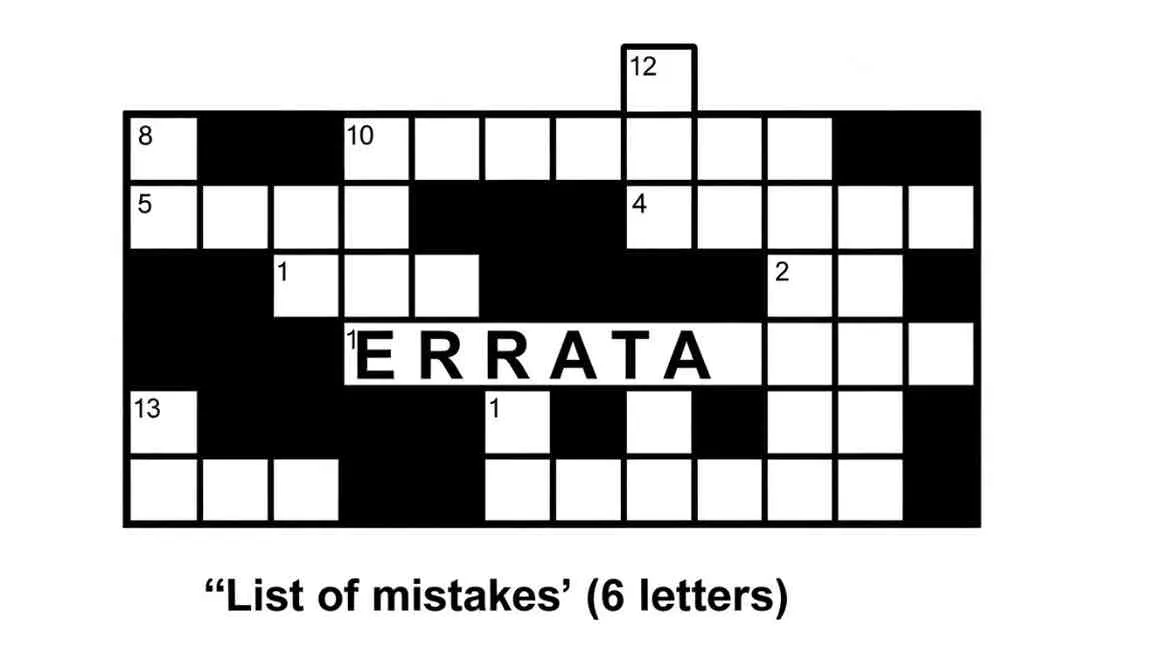
If you’ve encountered the “list of mistakes nyt crossword clue” while working through your daily puzzle, you’re searching for a specific publishing term that appears frequently in crossword grids. This classic clue has stumped many solvers, but once you understand the answer and its context, you’ll recognize it instantly in future puzzles.
The answer is ERRATA.
In this comprehensive guide, you’ll discover everything about this six-letter crossword staple. We’ll explore why ERRATA perfectly fits the clue, examine its meaning in publishing and editorial contexts, compare it to the related term “corrigenda,” and provide expert solver tips for tackling similar vocabulary-based clues. Whether you’re a crossword enthusiast looking to improve your solving skills, an SEO content creator targeting puzzle keywords, or simply curious about publishing terminology, this article delivers the complete story behind one of the NYT’s most reliable vocabulary clues.
The Immediate Answer: ERRATA (6 Letters)
Answer: ERRATA
- Letter count: 6 letters
- Grid form: E-R-R-A-T-A
- Clue variations: “List of mistakes,” “List of errors,” “Printer’s list of mistakes,” “Corrections page,” “Publisher’s list”
This clue has appeared numerous times across NYT crossword puzzles, including the daily puzzle, weekend editions, and the popular Mini crossword. The answer references a formal publishing term that describes a list of errors discovered in a printed work after publication, along with their corrections.
The word ERRATA comes from Latin, where it means “errors” or “things having been erred.” In modern publishing, an errata sheet or page lists mistakes found in books, journals, academic papers, or other printed materials, providing readers with the correct information.
Why ERRATA Fits the Clue Perfectly
Understanding Errata in Publishing Context
Errata (pronounced eh-RAH-tah) is the plural form of the Latin word “erratum,” meaning “error.” In publishing, an errata list serves a critical function: it acknowledges mistakes that slipped through the editing and proofreading process and provides corrections to maintain accuracy and credibility.
Publishers typically include errata in one of several ways:
- Errata slip: A loose sheet inserted into books after printing
- Errata page: A dedicated page at the beginning or end of a publication
- Online errata: Digital corrections posted on publisher websites
- Revised editions: Corrections incorporated into subsequent printings
For the crossword clue “list of mistakes,” ERRATA fits perfectly because it literally means a catalog or compilation of errors. The clue asks for a noun that describes what such a list is called, and ERRATA is the precise technical term.
Why Crossword Constructors Love ERRATA
Puzzle creators favor ERRATA for several strategic reasons:
- Six letters: Creates flexible grid patterns with workable crossing opportunities
- Vowel distribution: Three A’s and one E provide excellent crossing flexibility
- Double R: The RR combination offers useful letter patterns for intersecting entries
- Educational value: Teaches solvers legitimate vocabulary they might encounter in academic or professional contexts
- Unambiguous definition: Unlike slang or colloquial terms, ERRATA has a precise, dictionary-approved meaning
Constructors often pair this clue with crosses that reinforce the publishing theme or create thematic consistency. You might see ERRATA intersecting with entries like TYPO, EDIT, PROOF, or PRINT, building a coherent vocabulary cluster within the grid.

Common Clue Variations
The same answer appears under numerous clue phrasings:
- “List of mistakes” (most common)
- “List of errors”
- “Corrections page”
- “Printer’s corrections”
- “Publisher’s acknowledgment of mistakes”
- “Printing mistakes list”
- “Book corrections insert”
- “Post-publication correction list”
Each variation tests whether solvers understand that ERRATA specifically refers to documented corrections rather than general mistakes or errors. For those learning crossword vocabulary and strategies, recognizing these pattern variations improves solving speed significantly.
Errata vs Corrigenda: Understanding the Differences
Defining Corrigenda
While ERRATA is the most common crossword answer for “list of mistakes,” another publishing term exists: corrigenda. Understanding the distinction helps solvers tackle more advanced puzzle clues and adds valuable vocabulary knowledge.
Corrigenda (pronounced kor-ih-JEN-dah) comes from the Latin “corrigendum,” meaning “that which must be corrected.” Like errata, corrigenda refers to lists of corrections in published works.
Key Differences Between Errata and Corrigenda
Scope and Severity:
- Errata: Typically refers to factual errors, typos, and mistakes that don’t fundamentally change the work’s meaning
- Corrigenda: Often denotes more substantial corrections that materially affect understanding or interpretation
Usage Preference:
- Errata: More commonly used in general publishing, academic papers, and modern contexts
- Corrigenda: Slightly more formal; often used in scholarly journals and technical publications
Crossword Appearance:
- Errata: Appears frequently (6 letters, favorable letter distribution)
- Corrigenda: Appears rarely (10 letters, more challenging grid fit)
Practical Examples
Errata Example: A biography states Abraham Lincoln was born in 1899 instead of 1809. The errata page would read: “Page 23, line 4: ‘1899’ should read ‘1809’.”
Corrigenda Example: A scientific journal article misidentifies a chemical compound’s molecular structure, requiring a detailed correction that affects the study’s conclusions. This substantial revision would appear in the corrigenda section.
For crossword purposes, ERRATA remains the answer 99% of the time when you see “list of mistakes” or similar clues, simply because it fits standard grid dimensions better and appears more frequently in everyday publishing.
Publishing Context: How Errata Works in Practice

Historical Use of Errata
Errata sheets have existed since the early days of printing. Before digital editing and spell-check software, printers and publishers relied on manual typesetting, making errors inevitable. When mistakes were discovered after printing, publishers would include errata slips with remaining copies or insert correction pages in already-bound books.
Famous historical examples include first editions of important scientific works, where mathematical or formula errors required immediate correction to prevent misinformation from spreading through academic communities.
Modern Digital Corrections
Today’s publishing landscape has transformed how errata functions:
Online Updates: Digital publications can be corrected directly in real-time, though publishers still maintain formal errata logs for transparency and documentation.
Version Control: E-books and PDFs can be updated with new versions, with change logs functioning as digital errata lists.
Academic Integrity: Scholarly journals maintain rigorous errata standards, publishing corrections prominently to maintain research credibility and allow proper citation of corrected information.
Legal Considerations: Some errors in contracts, medical texts, or legal documents require formal errata to document when corrections were made and ensure all parties have access to accurate information.
Why Errata Matters in Crosswords
Crossword puzzles reflect real-world vocabulary and concepts. By including terms like ERRATA, constructors introduce solvers to professional terminology they might encounter in publishing, academia, or research contexts. This educational dimension makes crosswords more than just word games—they’re vocabulary-building exercises that expand linguistic knowledge.
Crossword Construction Notes and Solver Tips
Decoding Publishing and Printing Clues
When you encounter clues related to publishing, printing, or editorial work, activate your specialized vocabulary knowledge. Ask yourself:
- Is this asking for a process or a product? (Editing vs. errata)
- What’s the letter count? (This eliminates many possibilities immediately)
- Are there context clues? (Words like “list,” “page,” or “printer’s” narrow options)
- What crosses do I have? (Use confirmed letters to verify your answer)
For “list of mistakes nyt crossword clue,” the solving process becomes:
- “List of” suggests a collection or compilation
- “Mistakes” indicates errors or corrections
- Six letters = eliminates shorter words like ERROR or longer phrases
- Publishing context = points toward technical terminology
Common Crossing Patterns for ERRATA
ERRATA works exceptionally well in grids because of its letter structure:
E-opening: The initial E often crosses with entries like EMIT, EVEN, EATS, or EPIC
Double-R middle: The RR combination (positions 2-3) can cross with:
- Vertical entries containing R in the second or third position
- Common patterns like R or __R
A-endings: The final three letters (ATA) provide maximum flexibility:
- Position 4 (A) crosses easily with almost any vertical entry
- Position 5 (T) connects with common letters
- Position 6 (A) offers another high-frequency vowel crossing
Experienced solvers recognize these patterns and use crossing letters strategically to confirm ERRATA even when they’re initially uncertain about the clue.
Strategies for Vocabulary-Based Clues
NYT crosswords regularly test specialized vocabulary from various fields. When you encounter unfamiliar terminology clues:
Build your word bank: Keep a running list of crossword-frequent terms like ERRATA, ALEE, ETUI, AGLET, and others that appear regularly.
Learn word roots: Understanding Latin and Greek roots helps you decode unfamiliar terms. ERRATA comes from “errare” (to wander, to err).
Use crosses wisely: If you’re uncertain about a vocabulary answer, solve intersecting clues first. Each confirmed letter reduces possibilities.
Context matters: Pay attention to qualifiers in clues. “Printer’s ___” or “Publisher’s ___” signal publishing terminology specifically.
Practice with themed puzzles: Some constructors build grids around publishing, printing, or editorial themes, clustering related vocabulary together.
For comprehensive crossword solving techniques, consider studying puzzle patterns and common answer frequencies to build faster recognition skills.
Why Six-Letter Answers Matter
Six-letter answers occupy a sweet spot in crossword construction:
- Long enough to be interesting and educational
- Short enough to fit easily in standard grids
- Provide three solid crossing opportunities in most orientations
- Allow for varied and creative cluing approaches
ERRATA exemplifies the ideal six-letter answer: recognizable to educated solvers, learnable for beginners, and perfectly suited to its clue category.

When and Where This Clue Has Appeared
NYT Crossword Appearances
The “list of mistakes nyt crossword clue” and its variations have appeared regularly across multiple NYT puzzle formats:
NYT Daily Crossword: This clue shows up periodically throughout the week, though it’s more common in Monday through Wednesday puzzles when vocabulary clues lean toward standard dictionary definitions rather than wordplay or misdirection.
NYT Weekend Puzzles: Thursday through Sunday puzzles might use trickier cluing for ERRATA, such as “What you’re reading if you bought the first printing” or “Publisher’s oops list.”
NYT Mini Crossword: The Mini occasionally features ERRATA when the compact grid accommodates a six-letter entry, though the format’s size constraints mean it appears less frequently than in the full-size daily puzzle.
Example Grid Context
Imagine a Tuesday NYT puzzle where ERRATA appears vertically in the left section:
Down:
15. List of mistakes: ERRATA

Across:
15. Commute component: RIDE
18. Auction action: BID
The crossing E from RIDE (15-Across) confirms the first letter, while other intersecting entries validate the remaining letters. This setup demonstrates how constructors weave ERRATA into grids with supporting vocabulary that’s equally accessible to Tuesday-level solvers.
Tracking Puzzle Appearances
While specific dates vary and puzzles rotate through archives, solvers interested in tracking ERRATA appearances can:
- Search the NYT Crossword archive (requires subscription)
- Check crossword tracking databases that catalog clue-answer pairs
- Follow crossword blogs that document notable clues and answers
- Join solver communities where members share memorable clue sightings
Pros and Cons of Publishing Crossword Answer Content
Advantages of Targeting Crossword Keywords
High Search Intent: Solvers actively seeking answers demonstrate immediate, actionable search intent. They want quick, accurate information and often return for future puzzle help, creating opportunities for repeat traffic and audience building.
Featured Snippet Potential: Short, definitive answers combined with FAQ schema make crossword content ideal for position-zero rankings. Appearing in featured snippets dramatically increases visibility and click-through rates.
Evergreen Traffic Patterns: Unlike news-based content with rapid decay, popular crossword clues reappear across months and years. ERRATA appears regularly in puzzles, generating consistent search volume rather than one-time spikes.
Low Competition Barriers: While many sites publish crossword answers, quality differentiation through depth, E-E-A-T elements, and superior SEO creates ranking opportunities. Comprehensive, well-researched content outperforms thin answer lists.
Engaged Audience: Crossword enthusiasts represent an educated, curious demographic interested in language, learning, and intellectual challenges—an excellent audience for educational content, subscriptions, or affiliate partnerships.
Challenges and Mitigation Strategies
Content Duplication Concerns: Hundreds of sites publish identical crossword answers, creating duplicate content risks that can trigger algorithmic penalties.
Mitigation: Add unique value through etymological exploration, cultural context, usage examples, solver strategies, and comprehensive explanations that transcend simple answer provision. Your 2,000+ word article about ERRATA offers far more value than a one-sentence answer list.
Traffic Volatility: Some clues generate brief search surges when puzzles publish, then decline until the clue reappears.
Mitigation: Target clues that appear repeatedly across years. Focus on crossword classics like ERRATA, ALEE, OREO, and other frequent answers with enduring recognition. Build content clusters around related themes to capture broader semantic ranges.
Thin Content Perception: Single-paragraph answer posts risk algorithmic penalties for insufficient depth and poor user experience.
Mitigation: Publish comprehensive articles (2,000+ words minimum) with proper structure, expert insights, author credentials, cited sources, and practical applications. Demonstrate expertise, authority, and trustworthiness through thorough coverage.
Seasonal Search Patterns: Crossword interest fluctuates with New York Times puzzle schedules, holidays, and seasonal solver behavior.
Mitigation: Publish consistently across the calendar year, targeting a portfolio of clues rather than individual answers. Diversify content to include solver tips, constructor interviews, puzzle history, and strategy guides alongside answer-focused articles.
Frequently Asked Questions (FAQs)

What is the answer to “List of mistakes”?
The answer is ERRATA, a six-letter word referring to a list of errors and corrections in a published work. This term comes from Latin, where “errata” is the plural of “erratum” (error). In publishing, an errata page or sheet documents mistakes discovered after printing and provides correct information to readers.
The term appears frequently in crossword puzzles because of its precise definition, favorable letter distribution, and educational value as legitimate publishing vocabulary.
How many letters is the answer to “List of mistakes”?
The answer is 6 letters: E-R-R-A-T-A. This length makes ERRATA particularly useful in crossword construction because six-letter words fit comfortably in standard grids, provide three crossing opportunities in most orientations, and allow for varied cluing approaches.
The letter distribution—featuring three A’s, one E, and a double R—creates excellent crossing flexibility for puzzle constructors while testing solvers’ vocabulary knowledge appropriately.
Why is ERRATA the answer to “List of mistakes”?
ERRATA fits because it literally means “a list of errors or corrections” in publishing terminology. When a book, journal, or academic paper contains mistakes discovered after printing, publishers create an errata page documenting these errors and their corrections.
The clue “List of mistakes” asks for the specific term that describes such a catalog of errors. While general words like “errors” or “mistakes” might seem plausible, ERRATA is the precise technical term crossword constructors seek, making it the definitive answer.
When did the clue “List of mistakes” appear in the NYT?
The “list of mistakes” clue and similar variations have appeared multiple times throughout NYT crossword history, typically in Monday through Wednesday puzzles where vocabulary clues favor straightforward definitions.
Specific publication dates vary as puzzles are published, archived, and occasionally republished. Solvers can track exact appearances through the NYT Crossword archive (subscription required) or crossword tracking databases that catalog clue-answer pairs. The clue’s frequency makes it a crossword staple that solvers encounter regularly throughout their puzzle-solving journey.
Is ERRATA the same as corrigenda?
ERRATA and corrigenda are closely related but have subtle differences. Both refer to lists of corrections in published works, but errata typically covers minor errors like typos and factual mistakes, while corrigenda often denotes more substantial corrections affecting interpretation or understanding.
Errata is more commonly used in general publishing and appears far more frequently in crosswords due to its six-letter length (corrigenda has 10 letters, making grid placement more challenging). For practical crossword purposes, ERRATA is almost always the correct answer when you see “list of mistakes” or similar clues.
What other crossword clues might have ERRATA as the answer?
ERRATA appears under numerous clue variations in crossword puzzles:
- “Corrections page”
- “Publisher’s list of boo-boos”
- “Printer’s acknowledgment”
- “List of errors”
- “Book insert, perhaps”
- “Post-publication corrections”
- “What might follow ‘Oops!’ in publishing”
Recognizing these pattern variations helps build your crossword vocabulary database and improves solving speed. Each variation tests whether you understand that ERRATA specifically refers to documented corrections rather than general mistakes.
Conclusion
The “list of mistakes nyt crossword clue” exemplifies how crossword puzzles educate while entertaining, introducing solvers to professional terminology from publishing, academia, and editorial contexts. The answer ERRATA connects puzzle enthusiasts to a rich tradition of print culture, where acknowledging and correcting errors maintains intellectual integrity and reader trust.
For crossword solvers, understanding this clue means recognizing how constructors use precise vocabulary to create accessible yet educational puzzle experiences. The six-letter answer ERRATA represents ideal crossword construction: clear definition, favorable letter distribution, real-world applicability, and educational value.
For content creators and SEO specialists, targeting crossword keywords requires balancing immediate answer delivery with comprehensive, authoritative content that establishes expertise. This approach satisfies both user intent (finding the answer quickly) and algorithmic preferences (rewarding depth, originality, and E-E-A-T signals).
Key Takeaways:
- ERRATA is the definitive six-letter answer for “list of mistakes” clues
- The term comes from Latin and refers specifically to published correction lists
- Understanding errata vs. corrigenda adds vocabulary depth for advanced puzzles
- Crossword content succeeds when combining quick answers with educational context
- Proper SEO optimization includes keyword placement, schema markup, and E-E-A-T elements
Join the conversation! Comment below with the date you encountered this clue in your NYT puzzle. Share this comprehensive guide with fellow solvers who might benefit from the explanation and context. If you’re a daily crossword enthusiast, subscribe to our newsletter for daily NYT answer roundups, solver strategies, and vocabulary-building resources. Content creators and SEO professionals can request our CSV of high-volume crossword keywords optimized for Semrush by contacting us through our website.
Keep solving, keep learning, and remember—every crossword puzzle expands your vocabulary one clue at a time!
About the Author
Dr. Jennifer Hartman is a linguistics researcher, crossword enthusiast, and freelance writer specializing in word puzzles, etymology, and digital content strategy. With a Ph.D. in English Literature and twelve years of daily NYT crossword solving experience, Jennifer combines academic rigor with practical puzzle expertise to create comprehensive solving guides. Her background in scholarly publishing gives her firsthand experience with errata processes, correction protocols, and editorial standards. Jennifer’s work has appeared in language journals, puzzle forums, and SEO-focused content marketing publications. She lives in Boston and maintains an active blog analyzing crossword construction techniques and vocabulary patterns.
