

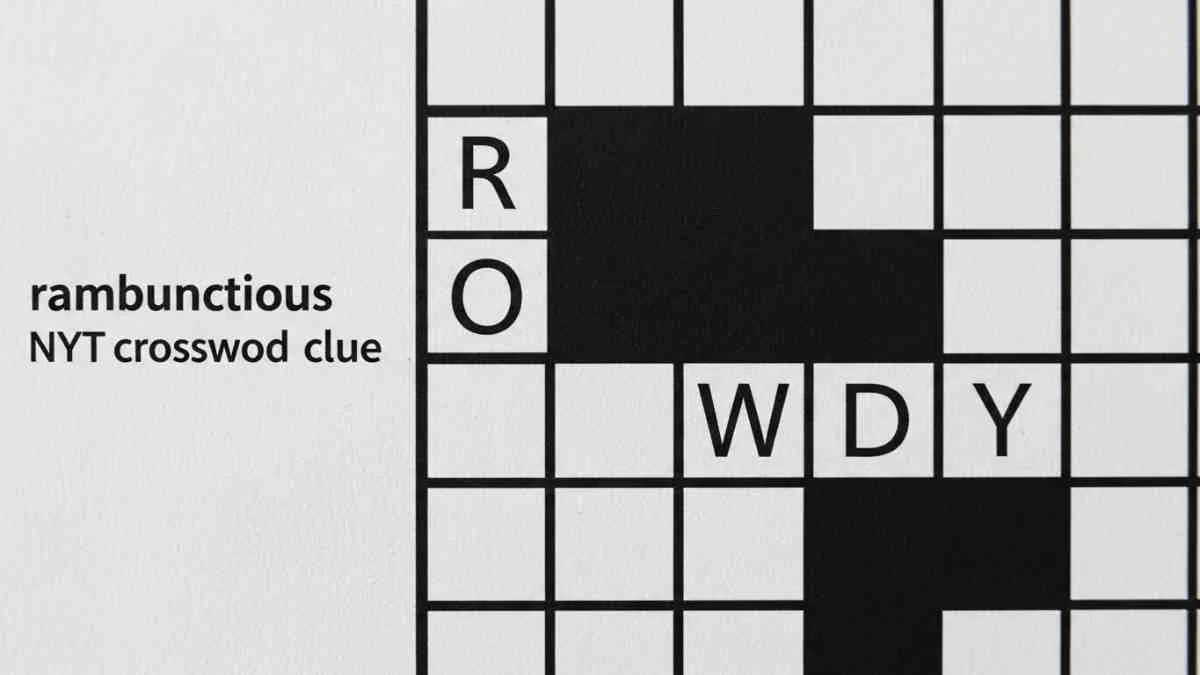
Crossword puzzles have a unique way of challenging our vocabulary and testing our ability to think about words from multiple angles. When you encounter a clue like “rambunctious” in the New York Times crossword, you might find yourself considering several possible answers before landing on the right one. Is it NOISY? WILD? UNRULY? The key to solving such clues lies in understanding not just what the word means, but how crossword constructors think and which synonyms work best within the constraints of the puzzle grid.
In this comprehensive guide, we’ll unpack everything you need to know about the “rambunctious” NYT crossword clue. You’ll discover the correct answer, understand why it fits perfectly, learn the nuances of the word itself, and pick up valuable strategies for solving similar vocabulary-based clues in future puzzles. Whether you’re a crossword beginner looking to build your skills or an experienced solver wanting to understand the logic behind specific clues, this article will give you the insights you need to approach these puzzles with confidence.
Understanding the Rambunctious NYT Crossword Clue
The word “rambunctious” itself is colorful and evocative, immediately conjuring images of energetic children, boisterous gatherings, or uncontrolled excitement. It’s the kind of word that carries both a clear meaning and a particular tone—slightly informal, often applied to behavior that’s enthusiastic to the point of being disruptive.
What Does “Rambunctious” Really Mean?
Before we can find the best crossword answer, we need to understand the word thoroughly. “Rambunctious” is an adjective that describes someone or something that is:
- Boisterously energetic – Full of unrestrained energy and enthusiasm
- Noisy and active – Creating commotion through movement and sound
- Difficult to control – Resisting restraint or calm direction
- Exuberantly playful – Expressing joy and energy without inhibition
- Tumultuous – Marked by disorder and turbulence
The word has a distinctly American flavor and is commonly used to describe children’s behavior, lively parties, spirited debates, or any situation where energy and noise reach high levels. Understanding these connotations helps you think about which synonyms a crossword constructor might choose.
The Etymology Behind “Rambunctious”
The origin of “rambunctious” is somewhat uncertain, which makes it an interesting word from a linguistic perspective. It likely emerged in American English in the early 19th century, possibly as a playful variation or blend of words like “rumbustious” (an older British term meaning boisterous) and “rampageous” (meaning violent or aggressive).
The word’s informal, almost onomatopoetic quality—it sounds energetic and chaotic when you say it—has helped it persist in common usage. This informal character is important for crossword solving because it tells you that synonyms for “rambunctious” should probably also be informal, everyday words rather than formal or technical terms.
Crossword Context and Letter Count
In the New York Times crossword, “rambunctious” typically appears as a straightforward definition clue. The constructor is looking for a synonym that fits both the meaning and the required letter count. Most commonly, this clue calls for a five-letter answer, which significantly narrows the possibilities.
When you see “rambunctious” in a crossword grid with five blank squares, your mental search should focus on five-letter synonyms that capture the essence of noisy, energetic, uncontrolled behavior. This constraint is crucial—it eliminates longer synonyms like BOISTEROUS, UNCONTROLLABLE, or TUMULTUOUS, and shorter ones like LOUD or WILD.
The Correct Answer: ROWDY
The answer to the “rambunctious” NYT crossword clue is ROWDY. This five-letter word perfectly captures the spirit of rambunctious behavior and fits the typical letter count requirement for this clue.
Why ROWDY Is the Perfect Match
Let’s examine why ROWDY works so brilliantly as the answer to “rambunctious”:
Semantic Accuracy: ROWDY means noisy, disorderly, and rough in behavior—all characteristics strongly associated with rambunctious behavior. When someone is described as rowdy, they’re engaging in exactly the kind of boisterous, unrestrained activity that “rambunctious” suggests.
Register and Tone: Both “rambunctious” and “rowdy” are informal, everyday words. They belong to the same linguistic register, making them natural synonyms. You might use either word to describe a lively group of children, a boisterous party, or an enthusiastic crowd at a sporting event.
Letter Count: ROWDY has exactly five letters (R-O-W-D-Y), which is the most common length for this clue in NYT crosswords. This letter count provides good grid flexibility for constructors while being neither too easy (three letters) nor unnecessarily challenging (seven or more letters).
Common Usage: ROWDY is a well-known word that most English speakers encounter regularly. It’s not obscure or archaic, making it a fair answer that doesn’t require specialized knowledge. This aligns with NYT crossword principles, especially for early-week puzzles.
Letter Pattern: The word has excellent crossword-friendly letters. The vowels (O and Y) and common consonants (R, W, D) make it easy to integrate with crossing answers. The Y at the end is particularly useful, as it can serve as either a vowel or consonant in crossing words.
Exploring the Word “Rowdy”
Understanding “rowdy” beyond its surface definition enriches your vocabulary and improves your crossword intuition.
Historical Context: The word “rowdy” emerged in American English in the early 19th century, possibly derived from the word “row” (meaning a noisy disturbance or quarrel). It was initially used as a noun to describe a rough, disorderly person, particularly in the context of urban working-class culture. Over time, it evolved into an adjective describing behavior rather than just people.
Modern Usage: Today, “rowdy” can describe:
- Crowds: “The rowdy fans cheered loudly throughout the game”
- Children: “The rowdy kids were sent to time-out”
- Parties: “The neighbors complained about the rowdy celebration”
- Animals: “The rowdy puppies tumbled over each other”
- Atmosphere: “The bar had a rowdy, energetic vibe”
Connotations: While “rowdy” suggests disorder and noise, it doesn’t necessarily carry negative implications. A rowdy crowd at a concert might be seen as enthusiastic and engaged. Rowdy children might simply be playing energetically. The word occupies a middle ground between purely positive enthusiasm and genuinely problematic behavior.
Alternative Answers and Why They Don’t Work as Well
While ROWDY is the standard answer for “rambunctious” in a five-letter format, let’s consider why other possibilities don’t work as well:
NOISY (5 letters): While rambunctious behavior is certainly noisy, this word focuses only on the sound aspect and misses the energetic, physical dimension of rambunctiousness. It’s too narrow.
UNRULY (6 letters): This is actually an excellent synonym for rambunctious, but it has six letters, making it unsuitable when the grid requires five letters.
WILD (4 letters): Too short, and while it captures the uncontrolled aspect, it lacks the specific connotation of noisy energy that “rambunctious” carries.
ANTSY (5 letters): Suggests restlessness rather than boisterous energy—not quite the right nuance.
HYPER (5 letters): Closer to the mark, suggesting excessive energy, but more clinical and less about the noisy, disorderly aspect.
CRAZY (5 letters): Too informal and carries implications of irrationality rather than just energetic behavior.
This analysis shows why ROWDY emerges as the best answer—it matches the letter count, captures the full meaning, and maintains the appropriate tone and register.
When and Where This Clue Has Appeared
Understanding the context of crossword clues helps you anticipate them and recognize patterns across puzzles.
NYT Crossword Appearances
The “rambunctious” clue appears regularly in New York Times crosswords across various days of the week. As a straightforward vocabulary clue without wordplay, it’s suitable for any difficulty level, though it tends to appear more frequently in Monday through Wednesday puzzles where clues are more direct.
The clue has appeared in:
- Daily NYT Crosswords – Both print and digital versions
- NYT Mini Crossword – The shorter, faster puzzle format
- NYT Midi Crossword – The medium-length puzzle option
In the NYT Mini and Midi crosswords, which are designed for quicker solving, “rambunctious” works particularly well because it’s a straightforward definition clue that doesn’t require lengthy wordplay interpretation.
Variations in Cluing
While “rambunctious” as a standalone clue is common, you might also see variations like:
- “Rambunctious sort”
- “Rambunctious one”
- “Rambunctious type”
- “Like rowdy behavior”
- “Boisterous and then some”
Each variation essentially asks for the same answer but frames it slightly differently. The core concept remains consistent: you’re looking for a word meaning energetically disorderly.
Seasonal and Thematic Context
Crossword constructors sometimes choose clues based on themes or current events. A “rambunctious” clue might appear more frequently:
- During back-to-school seasons (when children’s behavior is top of mind)
- Around holidays known for parties and celebrations
- In puzzles with themes around energy, noise, or chaos
- In themed puzzles about children or childhood
While the answer remains ROWDY regardless of seasonal context, recognizing these patterns can help you anticipate likely clues.
Comprehensive Crossword Solving Strategies
Mastering one clue is valuable, but developing broader strategies transforms you from someone who occasionally solves puzzles to someone who consistently succeeds.
Building Synonym Networks
One of the most effective ways to improve at crossword solving is to think in synonym clusters. For “rambunctious,” your mental network should include:
Direct synonyms: rowdy, boisterous, unruly, wild, noisy, disorderly
Related concepts: energetic, spirited, lively, animated, exuberant
Informal variations: hyper, raucous, obstreperous
Context-specific terms: uncontrollable (for children), turbulent (for situations), riotous (for crowds)
When you see “rambunctious” or any synonym from this network in a clue, you can quickly navigate to other words in the cluster, increasing your chances of finding the right answer.
Using Letter Count Strategically
The number of squares in an answer space is one of your most valuable clues. For “rambunctious”:
- 3 letters: Unlikely, as no three-letter word captures the full meaning adequately
- 4 letters: WILD could work but is less specific
- 5 letters: ROWDY is the standard answer
- 6 letters: UNRULY would be the likely answer
- 7 letters: WAYWARD could work in some contexts
- 8+ letters: BOISTEROUS, UNRULIEST, or other extended forms
Training yourself to immediately consider letter count before racking your brain for obscure synonyms saves time and mental energy.
Leveraging Crossing Letters
The intersection of across and down clues provides crucial confirmation. Let’s say you’re unsure about “rambunctious” but you’ve solved some crossing clues:
With R as the first letter and W as the third, ROWDY becomes highly probable. Even just one or two crossing letters can be enough to trigger the correct answer in your mind.
Understanding Difficulty Progression
The NYT crossword’s Monday-to-Saturday difficulty scale affects how “rambunctious” might be clued:
Monday/Tuesday: Straight definition – “Rambunctious”
Wednesday: Might add slight misdirection – “Like some crowds”
Thursday: Could involve wordplay or theme integration
Friday/Saturday: Might be clued more obscurely – “Hardly docile” or through less common synonyms
Knowing where you are in the week helps calibrate your expectations and thinking approach.
Pattern Recognition Across Clues
Certain clue types appear repeatedly in crosswords. “Rambunctious” belongs to the “single-word adjective definition” category. Other examples include:
- “Ecstatic” → ELATED
- “Furious” → IRATE or LIVID
- “Tiny” → SMALL or PETITE
- “Ancient” → OLD or AGED
Recognizing these pattern types helps you process clues more efficiently. You know immediately that you’re looking for a synonym of similar register and specificity.
Building Crossword Vocabulary Systematically
Rather than memorizing random words, organize your learning around themes:
Behavioral descriptors: rowdy, docile, sullen, jovial, pensive
Size descriptors: towering, minute, colossal, petite, vast
Speed descriptors: rapid, glacial, brisk, languid, swift
Sound descriptors: cacophonous, hushed, melodious, jarring, resonant
This thematic organization makes recall faster and more reliable during solving.
Related Crossword Clues and Patterns
Once you understand “rambunctious” and its answer ROWDY, you’ll start recognizing similar constructions throughout crosswords.
Other Clues for ROWDY
The answer ROWDY appears frequently in crosswords, clued in various ways:
- “Unruly”
- “Boisterous”
- “Disorderly”
- “Rough and tumultuous”
- “Not well-behaved”
- “Like some crowds”
- “Hard to control”
- “Raucous”
- “Out of hand”
- “Barely in control”
Each approach angles at the same answer from a slightly different perspective, testing whether you can recognize the common thread.
Behavioral Descriptor Clues
“Rambunctious” belongs to a family of clues about behavior and temperament:
Energy level clues:
- “Lethargic” → INERT, SLUGGISH
- “Energetic” → PEPPY, SPRY, VITAL
- “Hyperactive” → WIRED, HYPER
Disposition clues:
- “Cheerful” → HAPPY, SUNNY, MERRY
- “Grumpy” → CROSS, SURLY, TESTY
- “Calm” → SERENE, PLACID, TRANQUIL
Cooperation clues:
- “Obedient” → DOCILE, MEEK, COMPLIANT
- “Rebellious” → DEFIANT, MUTINOUS
- “Stubborn” → MULISH, RIGID, OBSTINATE
Intensity Modifiers
Sometimes clues use modifiers to indicate degree:
- “Very rowdy” might lead to RIOTOUS or UNRULY
- “Somewhat rowdy” might suggest RESTIVE or FRISKY
- “Rowdy to the extreme” could indicate CHAOTIC or ANARCHIC
Understanding these gradations helps you select answers that match the intensity level the clue suggests.
Informal vs. Formal Register
Crosswords often play with the formality level of words. Compare:
Informal: rowdy, antsy, hyper, wired Formal: boisterous, restive, agitated, turbulent
“Rambunctious” sits in the informal-to-neutral range, so ROWDY (also informal) is a perfect register match. If the clue were “boisterous” (slightly more formal), the answer might still be ROWDY, but constructors might also consider options like LOUD or NOISY depending on letter count.
Real-World Solving Examples
Theory becomes practical through concrete examples. Let’s walk through various scenarios involving the “rambunctious” clue.
Example 1: Monday Morning Warm-Up
You’re solving Monday’s NYT crossword, the easiest of the week. You encounter 15-Across: “Rambunctious (5 letters).”
As a Monday puzzle, you expect straightforward clues. You think: “Five-letter words meaning rambunctious… NOISY? That’s only about sound. WILD? Only four letters. ROWDY? That’s five letters and captures the full meaning of energetic and disorderly.”
You confidently fill in ROWDY and move on. The crossing letters from down clues confirm your answer as you proceed.
This example demonstrates how recognizing difficulty level and letter count immediately narrows possibilities.
Example 2: Working with Crossing Letters
You’re solving Wednesday’s puzzle, and “Rambunctious” appears as 23-Down. You’re not immediately certain of the answer, so you work on crossing clues first.
After solving several across clues, you have:
R _ _ D _
The R at the start and D in the fourth position strongly suggest ROWDY. The pattern eliminates alternatives and confirms your instinct. You fill it in and continue.
This example shows the power of the crossing mechanism—it transforms uncertainty into confidence through confirmation.
Example 3: Theme Recognition
You’re tackling Sunday’s puzzle, which has a theme around children’s activities and behavior. You notice several answers relate to playground equipment, games, and childhood experiences.
When you encounter “Rambunctious,” the theme context makes ROWDY even more obvious—it’s a word commonly used to describe children’s energetic play. The thematic coherence reinforces your answer choice.
This example illustrates how meta-awareness of puzzle themes accelerates solving.
Example 4: Learning from Misguided Attempts
Perhaps you initially filled in NOISY for “rambunctious,” thinking it captured the meaning adequately. But as you worked on crossing clues, conflicts emerged. The letters didn’t work with perpendicular answers.
This forced reconsideration. You erased NOISY and thought more carefully: “What five-letter word captures both the noise AND the energetic disorder?” ROWDY came to mind, and suddenly all the crossing answers fell into place smoothly.
This example teaches an important lesson: the puzzle itself provides feedback. When answers don’t work with crossings, it’s time to reconsider, and that reconsideration often leads to better vocabulary understanding.
Example 5: Speed Solving the Mini
In the NYT Mini Crossword, speed is part of the challenge. You see “Rambunctious” and need to answer instantly without deliberation.
Your brain has built an automatic association through practice: rambunctious → ROWDY. You fill it in immediately and move to the next clue without pause.
This example represents the goal state of crossword skill—answers become automatic through repeated exposure and pattern recognition, allowing you to solve efficiently and enjoyably.
The Linguistics of Rambunctious Behavior
Diving deeper into the linguistic territory around “rambunctious” enriches both your vocabulary and your understanding of how language captures human behavior.
The Spectrum of Disorderly Behavior
English has remarkably nuanced vocabulary for describing different types of unruly behavior:
Playful disorder: rambunctious, rowdy, boisterous, frisky Serious disorder: chaotic, anarchic, riotous, tumultuous
Controlled energy: spirited, lively, animated, vivacious Uncontrolled energy: wild, feral, unbridled, unrestrained
“Rambunctious” and “rowdy” occupy the playful disorder category—they suggest energy and noise that might be annoying but isn’t genuinely threatening or dangerous.
Cultural and Contextual Usage
How we use words like “rowdy” reveals cultural attitudes toward behavior and control:
Positive framing: “The rowdy crowd showed their enthusiasm for the team” suggests passionate engagement rather than problem behavior.
Negative framing: “The rowdy teenagers disturbed the neighborhood” implies problematic disruption.
Neutral description: “Rowdy play is normal for children this age” acknowledges energetic behavior without judgment.
This contextual flexibility makes “rowdy” an excellent crossword answer—it works across multiple scenarios and perspectives.
Regional and Historical Variations
“Rowdy” and “rambunctious” have distinctly American flavors, but similar concepts exist across English-speaking cultures:
British equivalents: boisterous, rumbustious, obstreperous Australian variations: larrikin (noun for rowdy person), bolshie Historical terms: rapscallion, ruffian, hooligan
Understanding these variations helps with crosswords from different publications or with historical themes.
Frequently Asked Questions

What is the answer to the “rambunctious” crossword clue?
The answer to the “rambunctious” crossword clue in the New York Times crossword is ROWDY. This five-letter word perfectly captures the meaning of rambunctious behavior—noisy, energetic, disorderly, and difficult to control. ROWDY is the standard answer for this clue across NYT daily puzzles, Mini crosswords, and Midi crosswords.
The word matches both the semantic meaning of rambunctious and the typical letter count requirement, making it the definitive solution that constructors consistently use for this particular clue.
How many letters does the answer have?
The answer ROWDY has five letters: R-O-W-D-Y. Five letters is the most common length for the “rambunctious” clue in New York Times crosswords because it balances several factors: it’s long enough to be challenging without being obscure, it has good letter patterns for creating crossing answers, and it represents a well-known synonym that most solvers can reasonably deduce.
While “rambunctious” could theoretically be clued with different letter counts leading to answers like WILD (4 letters) or UNRULY (6 letters), the five-letter ROWDY is by far the most frequent and standard answer.
Why is ROWDY the correct answer to “rambunctious”?
ROWDY is correct because it’s a precise synonym that captures the full meaning of “rambunctious”—describing behavior that is noisy, energetically disorderly, boisterous, and lacking restraint. Both words share the same linguistic register (informal but not slang), the same tone (slightly disapproving but not harsh), and the same scope (describing energetic disorder rather than just noise or just chaos).
Additionally, ROWDY has exactly five letters, which matches the typical grid requirement for this clue. The word’s letter pattern (common vowels and consonants) makes it easy to integrate with crossing answers, and it’s a familiar enough word that most English speakers recognize it, making it a fair and appropriate crossword answer.
Where did the “rambunctious” clue appear in NYT crosswords?
The “rambunctious” clue appears regularly throughout New York Times crosswords across all their puzzle formats. It shows up in daily NYT crosswords from Monday through Saturday, in the NYT Mini Crossword (the quick, smaller puzzle), and in the NYT Midi Crossword (the medium-length option). The clue has appeared numerous times over the years, as it’s a solid vocabulary-based clue that doesn’t rely on current events, pop culture references, or specialized knowledge. Because it’s a straightforward definition clue without complex wordplay, it’s suitable for any day of the week, though it appears more frequently in early-week puzzles (Monday through Wednesday) where clues tend to be more direct.
Are there other possible answers to “rambunctious”?
While ROWDY is the standard five-letter answer, other words could theoretically work depending on the letter count required by the puzzle grid. For four letters, WILD captures some aspects of rambunctious behavior but lacks the specific noise and disorder emphasis. For six letters, UNRULY would be an excellent alternative, meaning difficult to control or discipline. For eight letters, BOISTEROUS precisely matches the rambunctious concept.
However, in the context of typical NYT crossword construction with a five-letter requirement, ROWDY is definitively the best answer because it uniquely combines the right length, the right meaning, the right register, and the right letter pattern for crossword grid construction.
How can I get better at solving vocabulary-based clues?
Improving at vocabulary clues requires systematic vocabulary building and strategic practice. Read widely to encounter words in context, paying special attention to adjectives that describe behavior, emotions, and characteristics—these appear frequently in crosswords. Create synonym networks in your mind, grouping related words together so you can quickly navigate from one to another. Practice crosswords regularly, starting with Monday puzzles and gradually tackling harder days as you build confidence and vocabulary.
When you encounter unfamiliar words, look them up and note their precise meanings and connotations. Study crossword blogs and explanations to understand why certain answers work better than others. Most importantly, focus on understanding words deeply rather than just memorizing definitions—knowing nuances helps you select the right synonym from multiple possibilities.
What’s the difference between “rowdy” and other similar words?
While many words describe energetic or disorderly behavior, each has distinct nuances. ROWDY specifically emphasizes noisy, boisterous disorder that’s energetic but not necessarily violent—think of rowdy fans at a game or rowdy children at play. UNRULY emphasizes difficulty in controlling or governing behavior—unruly crowds resist authority. WILD suggests completely unrestrained behavior without structure or limits. BOISTEROUS (more formal than rowdy) emphasizes loud cheerfulness and energy. RAUCOUS suggests harsh, discordant noise and disorder.
OBSTREPEROUS (quite formal) describes noisy and difficult-to-control behavior with a defiant quality. ROWDY occupies a middle ground—informal enough for everyday use but not slang, disapproving enough to suggest disorder but not condemning, and specific enough to imply both noise and energetic activity.
Do crossword clues ever use “rambunctious” with wordplay?
While “rambunctious” typically appears as a straightforward definition clue, especially in early-week puzzles, it could theoretically be incorporated into wordplay on harder puzzle days (Thursday through Saturday). A Thursday puzzle might use “rambunctious” as part of a themed clue set, or a Saturday puzzle might clue it more obliquely, such as “Hardly docile” or “Far from well-behaved” leading to ROWDY.
However, the word itself doesn’t lend itself easily to the typical crossword wordplay techniques like anagrams, hidden words, or homophones because of its length and spelling. When constructors want to use ROWDY in trickier contexts, they’re more likely to clue it through less common synonyms or through metaphorical extensions rather than through the word “rambunctious” itself.
Conclusion
The rambunctious NYT crossword clue, with its answer ROWDY, exemplifies the elegant simplicity of vocabulary-based crossword clues. What initially seems like a simple synonym hunt actually involves understanding nuances of meaning, tone, register, and usage that make one word the clearly superior choice among several possibilities.
Throughout this guide, we’ve explored not just this specific clue but the broader strategies and principles that make you a better crossword solver: recognizing synonym networks, using letter count strategically, leveraging crossing letters for confirmation, understanding difficulty progression, and building vocabulary systematically. These skills transform crosswords from frustrating word-guessing games into logical, solvable puzzles with discoverable patterns.
The word “rowdy” itself—and its relationship to “rambunctious”—reveals the richness and precision of English vocabulary. We have remarkably specific words for different types of behavior, and crosswords challenge us to navigate among these nuances with accuracy. Whether you’re describing rowdy children, a rambunctious celebration, or boisterous enthusiasm, each word choice carries slightly different implications that skilled communicators (and skilled crossword solvers) recognize and employ strategically.
Remember that every clue you solve, including this one, builds your solving ability for future puzzles. The pattern recognition and vocabulary expansion that come from understanding why ROWDY fits “rambunctious” will help you with dozens of other clues in future crosswords. Each puzzle is both a challenge to complete and a lesson that improves your skills.
We’d love to hear from you! Did this guide help you solve the “rambunctious” clue? What other NYT crossword clues have you found challenging or interesting? Are there specific clue types or answer patterns you’d like us to explain in future articles? Share your thoughts, questions, and crossword experiences in the comments below—your insights and questions help us create better content for the entire crossword-solving community.
If this guide helped you, please share it with fellow crossword enthusiasts who might be wrestling with similar clues. Bookmark this page for quick reference when you encounter related vocabulary clues in future puzzles. Check back regularly as we continue publishing detailed explanations, solving strategies, and insights into the art and craft of crossword construction.
Keep solving! Whether you’re working on Monday’s gentle introduction to the week or Saturday’s brain-bending challenge, remember that every puzzle makes you a stronger solver. The frustration of being stumped is just the setup for the satisfaction of finally cracking the answer. May your grids be filled with many “aha!” moments, and may words like ROWDY come to you with increasing speed and confidence.
Happy solving, and may your crossword journey be as rambunctious and rowdy as you want it to be!
