

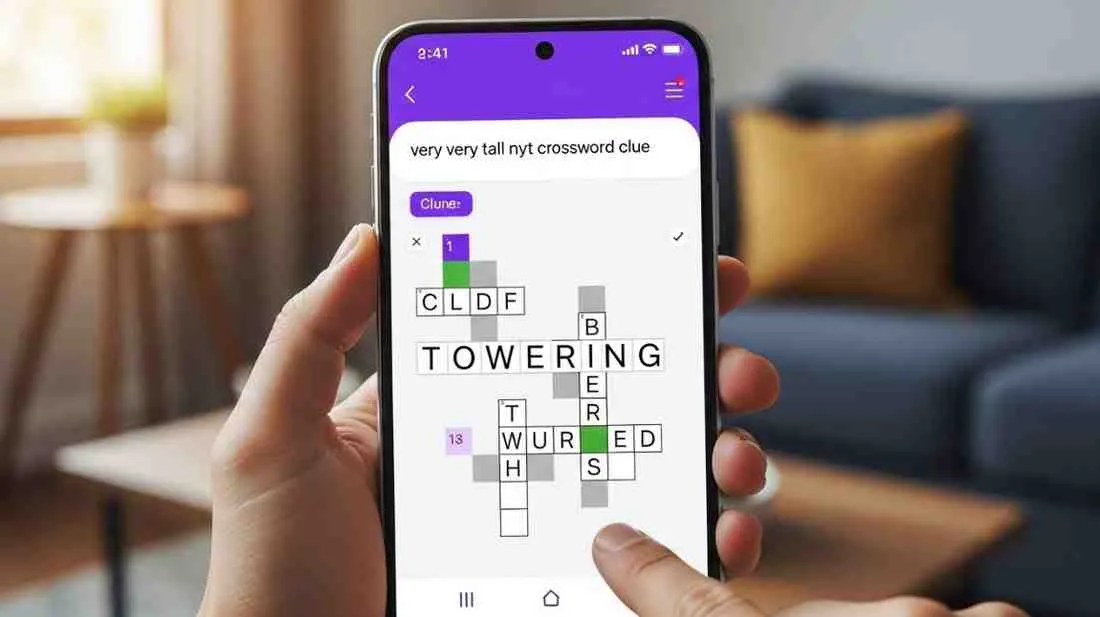
Have you found yourself staring at the clue “very very tall” in your New York Times crossword puzzle, wondering what eight-letter word could possibly fit? You’re in the right place. This seemingly simple clue has tripped up countless solvers, and understanding why the answer works reveals a lot about how crossword clues are constructed and how to approach them strategically.
In this comprehensive guide, we’ll reveal the correct answer to the very very tall NYT crossword clue, explain the logic behind it, and equip you with practical strategies for solving similar clues in future puzzles. Whether you’re a crossword newcomer feeling overwhelmed by wordplay or an experienced solver looking to sharpen your skills, this article will help you understand the elegant simplicity behind this particular clue and improve your overall puzzle-solving abilities.
Understanding the “Very Very Tall” NYT Crossword Clue
The phrase “very very tall” appears deceptively straightforward when you first encounter it in a crossword grid. Your mind immediately conjures images of skyscrapers, redwood trees, basketball players, or mountains. The repetition of “very” emphasizes extreme height, suggesting you need a word that captures not just tallness but exceptional, remarkable tallness.
The Nature of Descriptive Clues
In crossword puzzle construction, clues that stack descriptive words like “very very” serve a specific purpose. They’re asking you to find a single word that encapsulates the combined meaning of those repeated intensifiers. This is different from clues with wordplay or misdirection. Instead, it’s a vocabulary challenge that tests whether you know precise, evocative words that convey strong meanings.
The New York Times crossword has a long tradition of using elegant, sophisticated vocabulary. While Monday and Tuesday puzzles stick to more common words, puzzles later in the week introduce increasingly obscure or literary terms. A clue like “very very tall” could appear on any day of the week, but the specific answer might vary based on difficulty level and letter count requirements.
Context and Letter Count
When approaching any crossword clue, one of your first considerations should be the letter count. For the very very tall clue we’re discussing, the answer has eight letters. This immediately narrows your possibilities. You’re not looking for simple words like “huge” (four letters) or “gigantic” (eight letters, but doesn’t quite capture the vertical emphasis). You need something specifically related to height that fills exactly eight squares.
The letter count provides crucial constraints that guide your thinking. Combined with any crossing letters you’ve already filled in, these constraints often reduce the possibilities to just a handful of words, or sometimes just one obvious answer.
The Correct Answer: TOWERING
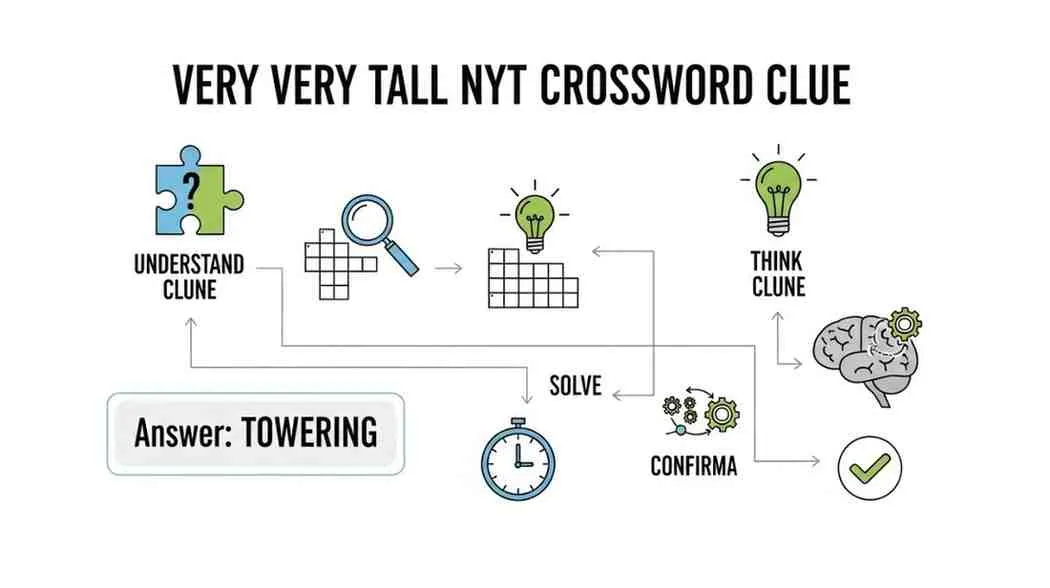
The answer to the “very very tall” NYT crossword clue is TOWERING. This eight-letter word perfectly captures the essence of extreme height and vertical dominance that the clue suggests.
Why TOWERING Is the Perfect Answer
Let’s break down why TOWERING works so brilliantly for this clue:
Literal Meaning: TOWERING directly relates to height. When something towers over something else, it rises far above it. The word derives from “tower,” a structure specifically designed to be tall. Using “towering” as an adjective emphasizes exceptional vertical dimension.
Intensity Match: The repetition of “very” in the clue signals that we need an intensified version of “tall.” TOWERING isn’t just tall, it’s dramatically tall, imposingly tall, remarkably tall. It’s the kind of word that would be used to describe the tallest things around—towering redwoods, towering skyscrapers, towering mountains.
Common Usage: While sophisticated, TOWERING is a relatively common word in English. You might describe someone as a “towering figure” in their field (metaphorically tall due to importance), or talk about “towering cliffs” along a coastline. This familiarity makes it a fair answer for crossword solvers.
Letter Pattern: The word has an excellent letter pattern for crosswords with its mix of common consonants and vowels: T-O-W-E-R-I-N-G. The presence of common letters like E, R, and I, along with the ING ending that appears in many English words, makes it work well with crossing answers.
Alternative Interpretations
While TOWERING is the standard answer for this specific clue when eight letters are required, it’s worth noting that crossword clues can sometimes have multiple valid solutions depending on the puzzle’s requirements. If the letter count were different, answers might include:
- GIGANTIC (8 letters) – though this emphasizes size generally rather than height specifically
- COLOSSAL (8 letters) – similar to gigantic in emphasizing overall size
- SKYHIGH (7 letters, sometimes written as two words) – emphasizes height specifically
- SOARING (7 letters) – suggests height with upward motion
- IMMENSE (7 letters) – emphasizes size but not specifically height
However, for the specific emphasis on vertical height indicated by “tall,” and the eight-letter requirement, TOWERING remains the most precise and appropriate answer.
The Deeper Meaning Behind “Towering”
Understanding the word TOWERING beyond its surface definition enriches both your vocabulary and your appreciation for precise language, which is at the heart of crossword puzzle solving.
Etymology and Word Origins
The word “tower” comes from Old English “torr” and Latin “turris,” referring to tall structures built for observation, defense, or religious purposes. Towers have existed throughout human civilization, from ancient ziggurats to medieval castle keeps to modern communication towers. The verb “to tower” emerged to describe something rising like a tower, and “towering” became the adjective form describing things that reach impressive heights.
This etymological connection is important because it grounds the word in a specific visual image: a tall, narrow structure that rises prominently above its surroundings. When you describe something as towering, you’re implicitly comparing it to a tower, suggesting not just height but also prominence and dominance over the landscape.
Metaphorical Uses
TOWERING extends beyond physical height into metaphorical territory, which is why it’s such a rich word for crossword constructors to use. Consider these common expressions:
Towering achievement – An accomplishment that stands far above others in significance or quality
Towering intellect – A mind that rises above others in capability and insight
Towering rage – Anger that has built to overwhelming proportions
Towering figure – A person of exceptional importance or influence in their field
These metaphorical extensions all rely on the core concept of height as a measure of superiority or intensity. Understanding these nuances helps you recognize “towering” as an answer even when the clue might be metaphorical rather than literal.
Synonyms and Related Words
Expanding your vocabulary of height-related words improves your crossword solving across the board. Here are words closely related to TOWERING:
- Imposing – Suggests impressive height that commands attention
- Lofty – Emphasizes height with connotations of elevation and grandeur
- Soaring – Height combined with upward motion
- Monumental – Great height combined with impressive scale
- Statuesque – Height combined with graceful proportion
- Sky-high – Colloquial term for extreme height
- Elevated – Raised to a high position or level
- High-rise – Specifically refers to tall buildings
Each of these words has slightly different connotations, and choosing among them depends on context. For the specific clue “very very tall,” TOWERING’s emphasis on dramatic vertical prominence makes it the ideal choice.
Comprehensive Crossword Solving Strategies
Solving “very very tall” successfully is just one small victory in the larger challenge of completing an entire crossword puzzle. Let’s explore strategies that will help you tackle this and similar clues with confidence.
The Power of Crossing Letters
Crossword puzzles are designed as interconnected grids where each letter serves double duty, appearing in both an across answer and a down answer. This crossing mechanism is your most powerful solving tool. Even if “very very tall” stumps you initially, filling in perpendicular answers gives you letters that narrow your possibilities dramatically.
For example, if you solve the down clues and discover that the second letter is “O” and the seventh letter is “N,” you have T-O-W-E-R-I-N-G as a very likely candidate. With just two confirmed letters, the answer often becomes obvious.
Building Vocabulary Systematically
Strong crossword solvers have extensive vocabularies, but this doesn’t mean memorizing dictionaries. Instead, focus on learning words in thematic groups. For height and size, study adjectives like:
Height-specific: towering, lofty, elevated, tall, high, soaring, sky-high
General size: enormous, immense, gigantic, colossal, massive, mammoth, vast
Impressiveness: imposing, majestic, grand, monumental, formidable
As you encounter new words in crosswords, write them down with their definitions. Over time, you’ll build a mental lexicon of crossword-friendly vocabulary that appears repeatedly across puzzles.
Recognizing Intensifier Patterns
The “very very” construction in this clue is an intensifier pattern. Crossword constructors use various methods to signal that they want a superlative or emphatic version of a concept:
- Repetition: “very very,” “quite quite,” “really really”
- Superlatives: “most tall,” “extremely tall,” “incredibly tall”
- Absolute terms: “completely,” “utterly,” “totally”
- Informal intensifiers: “super,” “mega,” “ultra”
When you see these patterns, your mental search should focus on strong, emphatic vocabulary rather than mild or neutral terms. You’re looking for words that command attention and convey extremes.
Working Across Difficulty Levels
The New York Times crossword operates on a well-established difficulty progression:
Monday: The easiest puzzle with straightforward clues and common vocabulary. “Very very tall” on a Monday might be clued even more directly, or might not require as sophisticated an answer.
Tuesday: Slightly harder with some wordplay beginning to appear, but still accessible to newer solvers.
Wednesday: Mid-week difficulty with more creative cluing and less common vocabulary.
Thursday: Known for gimmicks, tricks, and unusual puzzle construction. Clues become trickier.
Friday: One of the hardest puzzles with sophisticated cluing, obscure vocabulary, and heavy misdirection.
Saturday: Generally considered the most difficult puzzle of the week, with maximum trickiness and obscure knowledge.
Sunday: Larger puzzle roughly equivalent to Thursday in difficulty, often with elaborate themes.
Understanding where you are in the week helps calibrate your expectations. If you see “very very tall” on a Monday, you might expect a more common answer. On a Saturday, you should be prepared for something more sophisticated or obscure.
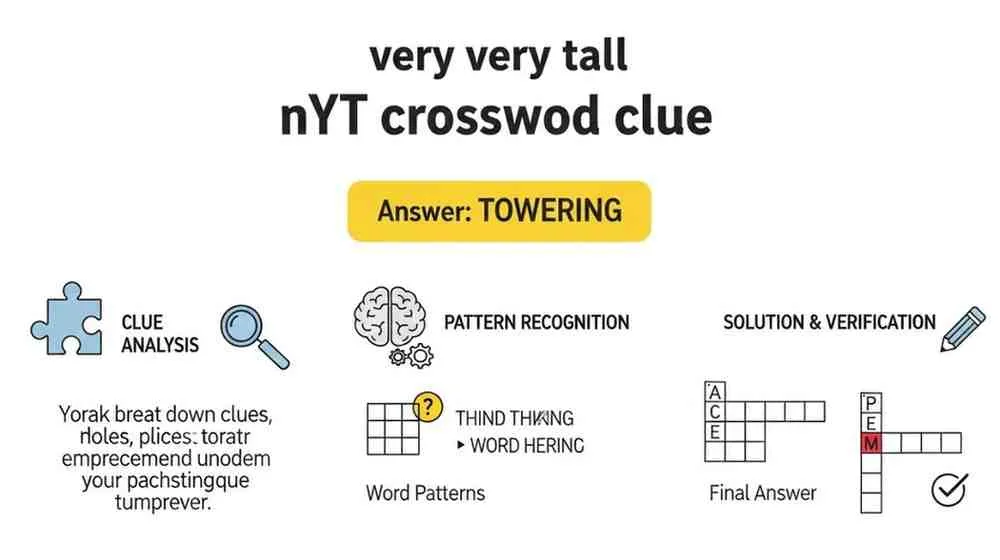
Strategic Solving Order
Don’t feel obligated to solve clues in numerical order. Many experienced solvers use this approach:
- Scan all clues first – Get a sense of the puzzle’s difficulty and identify easy entry points
- Fill in the gimmes – Start with clues you know immediately, especially fill-in-the-blanks
- Work on short answers – Three and four-letter words give you maximum crossing letters per square
- Build from clusters – Once you have a section partially filled, focus there to capitalize on crossing letters
- Return to hard clues – With crossing letters in place, previously impossible clues become solvable
- Leave the trickiest for last – Some clues require most of the puzzle to be complete before they become clear
This strategic approach transforms the puzzle from an overwhelming challenge into a series of manageable steps.
Using Letter Patterns and Common Endings
English has predictable patterns that help narrow possibilities. For an eight-letter word ending in ING (which TOWERING does), you know:
- The base word is likely five letters (TOWER)
- The word is probably a present participle or gerund
- Common letters like E, R, N, and T are likely present
Other useful patterns include:
- -TION endings (8 letters often means a 4-letter root plus this ending)
- -ABLE or -IBLE endings for adjectives
- -NESS endings for nouns derived from adjectives
- -LESS endings for adjectives meaning “without”
Recognizing these patterns helps you predict likely letter arrangements even before confirming them with crossings.
When and Where “Very Very Tall” Has Appeared
While specific occurrence data for individual clues varies, understanding the context in which “very very tall” and similar clues appear helps you anticipate them in future puzzles.
Frequency in NYT Crosswords
Descriptive clues like “very very tall” appear regularly in New York Times crosswords because they offer constructors a straightforward way to clue vocabulary words. Unlike clues that require elaborate wordplay or obscure knowledge, these vocabulary-based clues test your command of precise, evocative language.
TOWERING as an answer appears multiple times per year in NYT crosswords, though it’s clued differently each time. You might see:
- “Very very tall” (our focus clue)
- “Imposing in height”
- “Sky-high”
- “Head and shoulders above the rest”
- “Extremely lofty”
- “Like some achievements”
- “Impressive in stature”
Each clue approaches the word from a slightly different angle, keeping the puzzle fresh even when the answer repeats.
Puzzle Placement Patterns
Crossword constructors carefully consider where different types of answers go in the grid. Longer answers like TOWERING (eight letters) typically appear:
- In the middle sections of the puzzle where they can serve as anchors for surrounding shorter answers
- As theme answers if the puzzle has a height or size theme
- In positions where their letter patterns help create clean fills (sections with no awkward or obscure words)
The placement affects how you encounter the clue. If “very very tall” appears early in your solving process with no crossing letters yet filled, you’ll need to rely purely on vocabulary knowledge. If it appears later, crossing letters will guide you.
Variations in Other Puzzles
While we’re focusing on the NYT crossword, it’s worth noting that other crossword publishers use similar clues with their own stylistic variations:
USA Today Crossword: Tends toward more accessible vocabulary and straightforward cluing, so “very very tall” might appear more frequently in easier contexts.
Wall Street Journal Crossword: Known for clever themes and playful cluing, might add wordplay elements even to seemingly simple descriptive clues.
Los Angeles Times Crossword: Similar difficulty and style to NYT, so you’ll see comparable clue constructions.
The New Yorker Crossword: Often features trickier, more contemporary cluing that might approach “very very tall” from unexpected angles.
Understanding these stylistic differences helps you adjust your solving strategy when you work puzzles from different sources.
Related Crossword Clues and Patterns
Once you master “very very tall,” you’ll start recognizing similar clue patterns throughout crosswords. This pattern recognition accelerates your solving speed dramatically.
Other Intensifier Clues
The “very very” intensifier pattern appears with many different concepts:
“Very very small” – Answers might include MINUSCULE, TEENY-TINY, or MICROSCOPIC depending on letter count
“Very very angry” – Could be FURIOUS, ENRAGED, or IRATE
“Very very happy” – Might be ELATED, ECSTATIC, or OVERJOYED
“Very very cold” – Could be FREEZING, FRIGID, or ICY
“Very very fast” – Might be LIGHTNING (as in “lightning-fast”) or BREAKNECK
“Very very quiet” – Could be SILENT, HUSHED, or SOUNDLESS
Each of these follows the same pattern: the repetition of “very” signals that you need an emphatic, strong version of the base concept.
Height-Related Clues
Beyond “very very tall,” height appears in crosswords through various clue formulations:
“Sky-high” – Might be TOWERING, SOARING, or ELEVATED
“Reaching for the sky” – Could be SOARING or ASPIRING
“Head and shoulders above” – Might be TOWERING or SUPERIOR
“Lofty” – Could be ELEVATED, HIGH, or NOBLE (in the metaphorical sense)
“Imposing in stature” – Likely TOWERING or STATUESQUE
“Like mountains or skyscrapers” – Probably TOWERING, TALL, or SOARING
Adjective Intensity Scales
Understanding gradations of meaning helps you select the right answer. For height, the intensity scale might look like:
- Tall (neutral baseline)
- High (elevated position)
- Lofty (considerably tall with positive connotations)
- Soaring (very tall with upward motion)
- Towering (extremely tall, dominating the landscape)
When a clue uses intensifiers like “very very,” you’re looking at the higher end of this scale. TOWERING sits at or near the top, making it ideal for such clues.
The Art of Synonyms in Crosswords
Crossword solving largely involves finding the right synonym for the clue’s concept. But not just any synonym will do—you need the one that:
- Matches the required letter count exactly
- Works with the crossing letters from perpendicular answers
- Fits the puzzle’s difficulty level
- Matches the tone and style of the clue
For “very very tall,” you’re choosing among synonyms like towering, imposing, colossal, enormous, and gigantic. TOWERING wins because it specifically emphasizes vertical height (thanks to “tall” in the clue) and has exactly eight letters.
Real-World Crossword Solving Examples
Theory becomes clearer through concrete examples. Let’s walk through how you might encounter and solve the “very very tall” clue in different scenarios.
Example 1: Early-Week Puzzle with Support
Imagine it’s Tuesday morning, and you’re working through that day’s NYT crossword. You encounter 23-Across: “Very very tall (8 letters).”
You don’t immediately know the answer, so you move on to other clues. You successfully solve several down clues that cross through 23-Across, giving you these letters:
T _ W _ _ I N _
With these crossing letters in place, your mind starts working through possibilities. T at the start, W in position 3, I in position 7, and the final letter isn’t yet determined. The pattern strongly suggests TOWERING. You fill it in, and when the final crossing letter confirms G, you know you’re correct.
This example demonstrates the power of the crossing mechanism. What seemed impossible becomes obvious with just a few confirmed letters.
Example 2: Late-Week Challenge
Now imagine it’s Friday, one of the hardest puzzle days. You see “Very very tall (8 letters)” as 42-Across, and it’s in a section with no crossing letters filled yet.
You think through possibilities: “What eight-letter words mean extremely tall?” You consider GIGANTIC—but wait, that emphasizes size generally, not height specifically. ENORMOUS? Same issue. COLOSSAL? Still not quite right for height.
Then you think about words specifically related to height: TOWERING. That fits perfectly. Eight letters, directly relates to vertical dimension, strong emphasis matching the “very very” intensifier.
You tentatively fill in TOWERING and continue with other clues. As you solve crossing clues and the letters confirm your choice one by one, your confidence grows. Eventually, the puzzle validates your answer.
This example shows how vocabulary knowledge and precise thinking about word meanings can help you solve clues even without crossing letter support.
Example 3: Theme Integration
Suppose you’re solving a Sunday puzzle with a theme around architecture and skyscrapers. You notice several theme answers relate to famous tall buildings or architectural terms. When you encounter “Very very tall (8 letters),” the puzzle’s theme gives you additional context.
Given the architectural theme, TOWERING becomes an even more obvious choice, as it directly relates to towers—vertical structures that define skylines. This meta-awareness of puzzle themes helps you anticipate likely answers even before working through letter-by-letter confirmation.
Themed puzzles offer extra clues beyond the literal wording of individual prompts. Paying attention to themes accelerates your solving and adds another dimension of enjoyment to the puzzle.
Example 4: Learning from Mistakes
Perhaps you initially tried a different answer. Seeing “very very tall,” you thought GIGANTIC and filled it in confidently. But as you worked on crossing clues, nothing fit properly. Letters conflicted, and you couldn’t complete the perpendicular answers.
This forced you to reconsider. You erased GIGANTIC and thought more carefully about the “tall” emphasis. TOWERING came to mind, and suddenly all the crossing answers fell into place smoothly.
This experience teaches an important lesson: when answers don’t work with crossings, it’s time to reconsider. The puzzle itself provides feedback, helping you learn and adjust.
Frequently Asked Questions
What is the answer to the “very very tall” crossword clue?
The answer to the “very very tall” crossword clue in the New York Times crossword is TOWERING. This eight-letter word perfectly captures the extreme height suggested by the repetition of “very” in the clue. TOWERING means rising to a great height, imposingly tall, or reaching high above others.
The word derives from “tower,” emphasizing vertical prominence and dominance. While other words like “gigantic” or “colossal” might seem to fit, TOWERING specifically emphasizes height rather than general size, making it the most precise answer for this particular clue.
How many letters does the answer have?
The answer TOWERING has eight letters: T-O-W-E-R-I-N-G. This letter count is typical for mid-length crossword answers that serve as anchors in the puzzle grid. Eight-letter answers are long enough to be interesting and challenging, but not so long that they dominate the puzzle like theme entries often do. When you see the number of squares for a clue in the crossword grid, counting them immediately tells you how many letters the answer must have, which is crucial information for narrowing down possibilities.
Why does TOWERING fit this clue?
TOWERING fits the “very very tall” clue perfectly for several reasons. First, it directly addresses height—something that towers rises high above its surroundings. Second, the word has emphatic intensity matching the “very very” intensifier in the clue.
TOWERING isn’t merely tall, it’s impressively, dramatically tall. Third, the word has exactly eight letters, matching the typical answer length for this clue. Fourth, TOWERING has good crossword letter patterns with common letters like E, R, I, and N that work well with crossing answers. Finally, it’s specific to vertical height rather than general size, which the word “tall” in the clue emphasizes.
Where has this clue appeared in NYT crosswords?
While specific publication dates for individual clues aren’t always documented, “very very tall” and similar height-related clues appear regularly throughout NYT crosswords across all days of the week. The answer TOWERING appears multiple times per year in the New York Times crossword, though it’s clued in various ways.
Descriptive vocabulary clues like this one are staples of crossword construction because they test solvers’ command of precise, evocative language without requiring elaborate wordplay. You might encounter this clue in any daily puzzle from Monday through Saturday, or in the larger Sunday puzzle, though the surrounding clues and puzzle difficulty will vary.
Are there alternative answers to this clue?
While TOWERING is the standard and most accurate answer for “very very tall” when eight letters are required, alternative answers could theoretically work in different puzzle contexts. GIGANTIC (eight letters) emphasizes size but less specifically height. COLOSSAL (eight letters) similarly focuses on overall scale rather than vertical dimension.
IMPOSING (eight letters) could work in some contexts. However, these alternatives don’t capture the specific vertical emphasis of “tall” as precisely as TOWERING does. In crossword solving, the most precise answer that matches both the letter count and the specific nuance of the clue is always preferred, which is why TOWERING is the definitive answer for this particular clue.
What other words mean the same as TOWERING?
Numerous words relate to TOWERING, each with slightly different connotations. Imposing suggests impressive height that commands respect or attention. Lofty emphasizes elevation with connotations of grandeur or nobility. Soaring combines height with upward motion or flight. Monumental suggests great height combined with impressive scale and significance. Elevated means raised to a high position or level.
Sky-high is a colloquial term for extreme height. Statuesque combines height with graceful, dignified proportions. Each synonym has distinct nuances that make it more or less appropriate for different contexts, and crossword constructors choose carefully among them based on the specific effect they want to achieve.
How do I improve at solving NYT crossword clues?
Improving at NYT crosswords requires consistent practice combined with strategic learning. Solve puzzles regularly, starting with Monday puzzles if you’re newer to crosswords and gradually tackling harder days as you build confidence. Study the patterns and techniques used in clues, paying attention to wordplay, misdirection, and vocabulary.
Build your vocabulary systematically by learning words in thematic groups. Use crossing letters strategically—they’re your most powerful tool for confirming or discovering answers. Read crossword blogs and commentary to understand constructor thinking. Don’t be afraid to look up answers when stuck, as learning new words expands your solving ability. Most importantly, be patient with yourself and focus on enjoying the journey rather than achieving perfect completion rates.
What makes NYT crosswords different from other puzzles?
The New York Times crossword is widely regarded as the gold standard of American crosswords due to its consistently high editorial standards, clever construction, and well-calibrated difficulty progression. Each puzzle is carefully edited and tested to ensure fairness, accuracy, and solvability. The Monday-through-Saturday difficulty scale is reliable and well-established, allowing solvers to find appropriate challenges for their skill level.
NYT crosswords feature smooth fills with fewer obscure words, elegant and creative cluing, and sophisticated themes on themed puzzle days. The puzzles balance accessibility with challenge, welcoming newcomers while satisfying experienced solvers. This combination of quality, consistency, and tradition has made the NYT crossword a cultural institution with a dedicated community of solvers worldwide.
Conclusion
The very very tall NYT crossword clue, with its answer TOWERING, exemplifies the elegant simplicity that makes crossword puzzles so satisfying. What appears at first glance to be a straightforward descriptive clue actually tests your vocabulary precision, your ability to match intensity levels in language, and your skill at finding the exact word that captures a specific concept.
Beyond this single clue, we’ve explored broader principles that will serve you well across all crossword solving: the strategic use of crossing letters, the importance of building vocabulary in thematic groups, the value of recognizing intensifier patterns, and the need to calibrate your thinking based on puzzle difficulty. These strategies transform crosswords from frustrating challenges into logical, solvable puzzles.
Remember that TOWERING isn’t just an eight-letter answer to a clue—it’s a window into the precision and richness of the English language. The word carries connotations of dominance, impressiveness, and vertical majesty that make it far more evocative than simpler synonyms like “tall” or even “very tall.” Appreciating these nuances enriches not only your crossword solving but your overall command of language.
Whether you solved “very very tall” immediately or needed this guide to understand it, you’ve now added valuable knowledge to your crossword-solving toolkit. The next time you encounter an intensifier pattern like “very very” or a height-related clue, you’ll approach it with confidence and the right mental framework for finding the answer quickly.
Now it’s your turn! We’d love to hear about your experiences with this clue and others that have challenged you. Did you solve “very very tall” on your own, or did it stump you until you found this guide? What other NYT crossword clues have you found particularly clever or challenging? Share your thoughts, questions, and crossword victories in the comments below.
Keep the conversation going: If you found this guide helpful, share it with fellow crossword enthusiasts who might benefit from the insights. Bookmark this page for quick reference when you encounter similar clues in future puzzles. And if there are specific crossword clues you’d like us to analyze and explain, let us know in the comments—your suggestions help us create content that serves the crossword-solving community.
Stay connected: Check back regularly for more detailed crossword clue explanations, solving strategies, and insights into the art and craft of puzzle construction. The more you engage with crossword puzzles and the community around them, the more skilled and confident you’ll become as a solver.
Happy solving, and may your grids be filled with many satisfying moments of clarity and achievement!
